Executive Condo vs Private Condo
An executive condominium (EC) is bought new from a developer under HDB rules — an income ceiling, citizenship and a minimum occupation period — but built and run like a private condo. A private condo has no eligibility rules or income ceiling and can be bought by foreigners. ECs are cheaper upfront and may come with a grant, but you are locked in for years.
An executive condominium (EC) looks like a private condo but is bought under HDB rules. A private condo has no such strings. The trade-off is simple: an EC is usually cheaper and may come with a grant, but you accept an income ceiling, a lock-in period, and limits on who you can sell to for years.
At a glance
| Executive condo (EC) | Private condo | |
|---|---|---|
| Bought from | Developer, under HDB eligibility rules | Open market, anyone eligible |
| Income ceiling | S$16,000 (S$18,000 for sites tendered from 24 Aug 2026) | None |
| Citizenship | Must be a Singapore Citizen household | Citizens, PRs and foreigners |
| Minimum occupation period | 5 years (10 years for sites tendered from 8 May 2026) | None |
| Who you can sell to | No sale during MOP; SC/PR after MOP; foreigners only after privatisation | Anyone (Seller’s Stamp Duty may apply within 4 years) |
| Grant | Up to S$30,000 CPF Housing Grant (first-timers) | None |
Eligibility: ECs have rules, condos don’t
To buy a new EC you must form an eligible Singapore Citizen household (for example under the Public Scheme or, for two or more singles 35+, the Joint Singles Scheme), be at least 21, not own or have an interest in any local or overseas private residential property, and not have disposed of one in the last 30 months. The household income ceiling is S$16,000, rising to S$18,000 for EC projects with land tenders closing on or after 24 August 2026.
A private condo has no eligibility scheme, no income ceiling and no citizenship rule — foreigners can buy (with Additional Buyer’s Stamp Duty). Buyer’s Stamp Duty (IRAS) applies to both.
The lock-in: MOP and privatisation
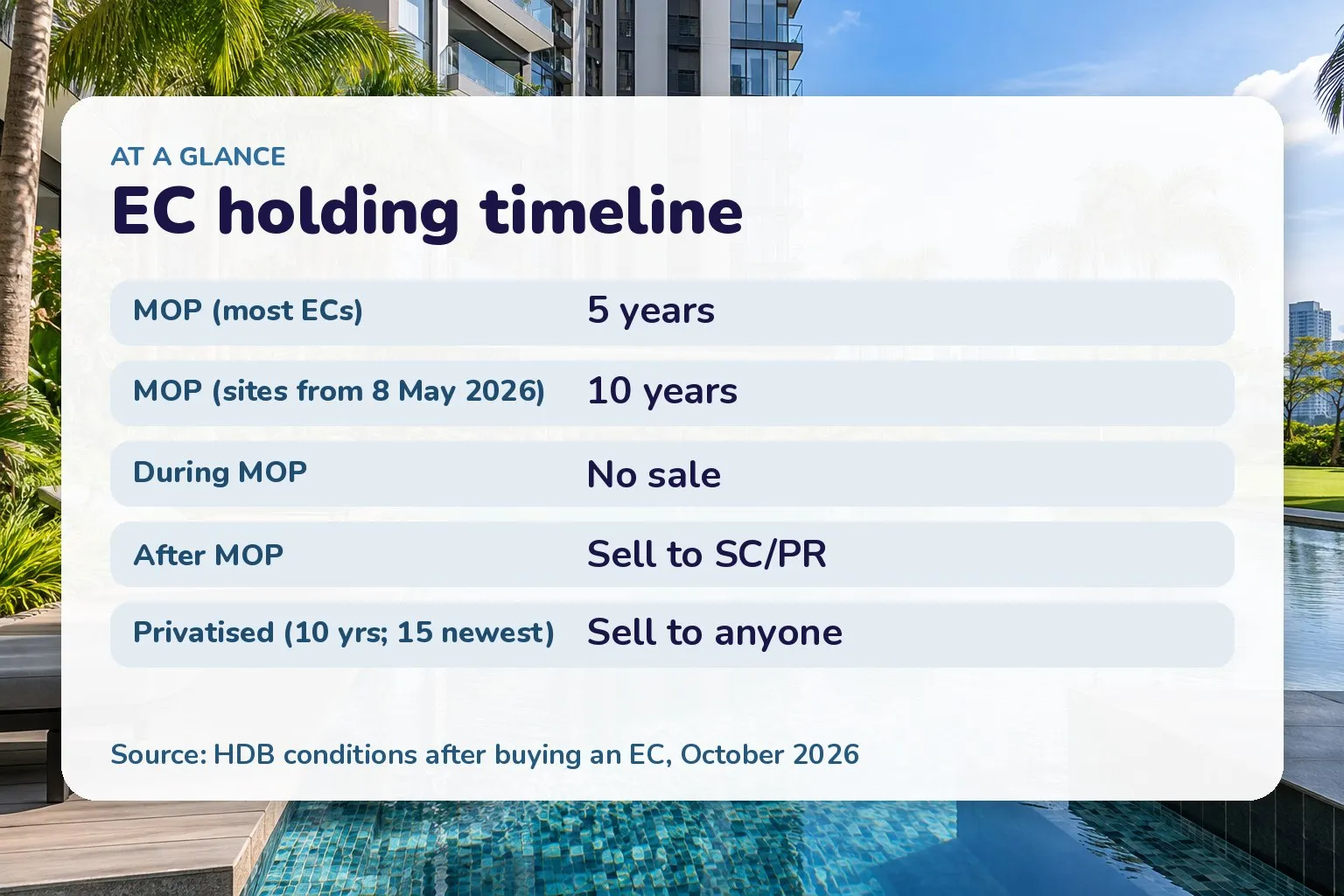
This is where an EC really differs from a condo. After collecting keys (from the Temporary Occupation Permit date) you must serve a minimum occupation period (MOP):
A private condo has no MOP, but Seller’s Stamp Duty can apply if you sell within 4 years.
- 5 years for most ECs — and the four EC projects launched in 2026 keep this.
- 10 years for new EC sites where the land tender closed on or after 8 May 2026.
During the MOP you cannot sell or rent out the whole unit. After the MOP you may sell to Singapore Citizens and PRs. The EC only becomes fully privatised — sellable to foreigners too — after 10 years (or 15 years for the newest sites). A private condo has no MOP, but residential property bought on or after 4 July 2025 attracts Seller’s Stamp Duty if sold within 4 years.
Grants and cost
First-timer EC households may receive a CPF Housing Grant of up to S$30,000 (the amount depends on household income and citizenship mix). Private condos attract no grant. Second-timer households buying a new EC from the developer may also have to pay a resale levy — see the resale levy guide. ECs typically launch below comparable private condo prices, which, with the grant, is their main financial appeal.
Which suits you?
- Choose an EC if you meet the eligibility and income ceiling, want condo facilities at a lower entry price, can accept the MOP and resale limits, and may qualify for the grant.
- Choose a private condo if you are over the income ceiling, want full flexibility to sell or rent immediately, or are not a Singapore Citizen household.
Both are subject to the TDSR limit (and MSR for a new EC), so model your repayments before you shortlist.
Related
General information, not property or financial advice. Check HDB and IRAS for current rules and duties.
Sources
- Eligibility for Buying an Executive Condominium — Housing & Development Board (as of October 2026)
- Conditions After Buying an Executive Condominium — Housing & Development Board (as of October 2026)
- CPF Housing Grant for an Executive Condominium — Housing & Development Board (as of October 2026)