TDSR and MSR Limits Explained

TDSR caps your total monthly debt repayments at 55% of gross monthly income. MSR separately caps housing-loan repayments at 30% of income, but only for HDB flats and new executive condos. Banks size your loan using a stress-test rate — the higher of 4% or the prevailing rate — so your maximum loan is based on that floor, not today's advertised rate.
Two rules from the Monetary Authority of Singapore (MAS) decide how much you can borrow for a home: the Total Debt Servicing Ratio (TDSR) and the Mortgage Servicing Ratio (MSR). TDSR caps all your monthly debt at 55% of gross monthly income; MSR caps the home loan alone at 30%, but only for HDB flats and executive condos (ECs).
TDSR: 55% of income, all debts counted
TDSR is the main limit for every property loan. MAS sets the formula as:
Total monthly debt obligations ÷ gross monthly income × 100% — capped at 55%.
“Total monthly debt” includes the new mortgage plus car loans, personal loans, credit-card instalments, student loans and any other property loans. So the more existing debt you carry, the less room is left for a home loan.
MSR: 30%, HDB and EC only
MSR is an extra cap that applies only to loans for HDB flats and ECs bought from a developer. It limits the housing-loan repayment to 30% of gross monthly income. Private condo and landed purchases are not subject to MSR — only TDSR.
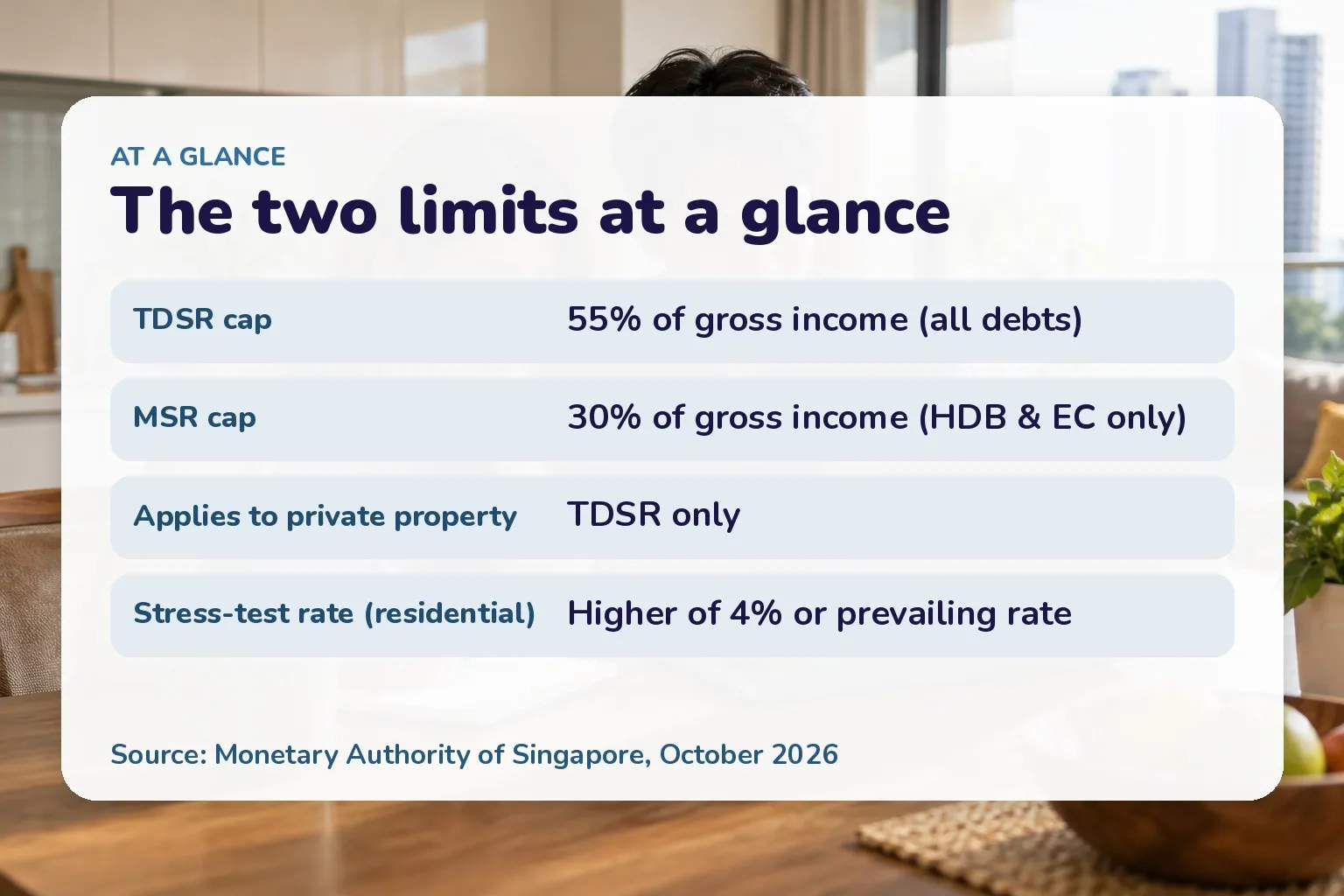
TDSR covers all debt; MSR adds a tighter cap for HDB flats and ECs.
For HDB and EC buyers, both rules apply at once, and the 30% MSR is usually the tighter of the two, so it is the one that caps your loan.
The stress-test rate matters more than the advertised rate
Lenders do not size your loan on the low promotional rate you see advertised. They use a medium-term stress rate — for residential property purchase loans, the higher of 4% or the prevailing rate — when computing TDSR. HDB applies its own floor (currently 3%) to work out an eligible HDB loan amount. This is deliberately conservative so you can still afford repayments if rates rise.
Worked example
| Figures | |
|---|---|
| Gross monthly household income | S$8,000 |
| MSR cap (30%) | S$2,400 available for the home loan |
| TDSR cap (55%) | S$4,400 available for all debt |
| Existing car loan | S$900/month |
| TDSR room left for mortgage | S$3,500 |
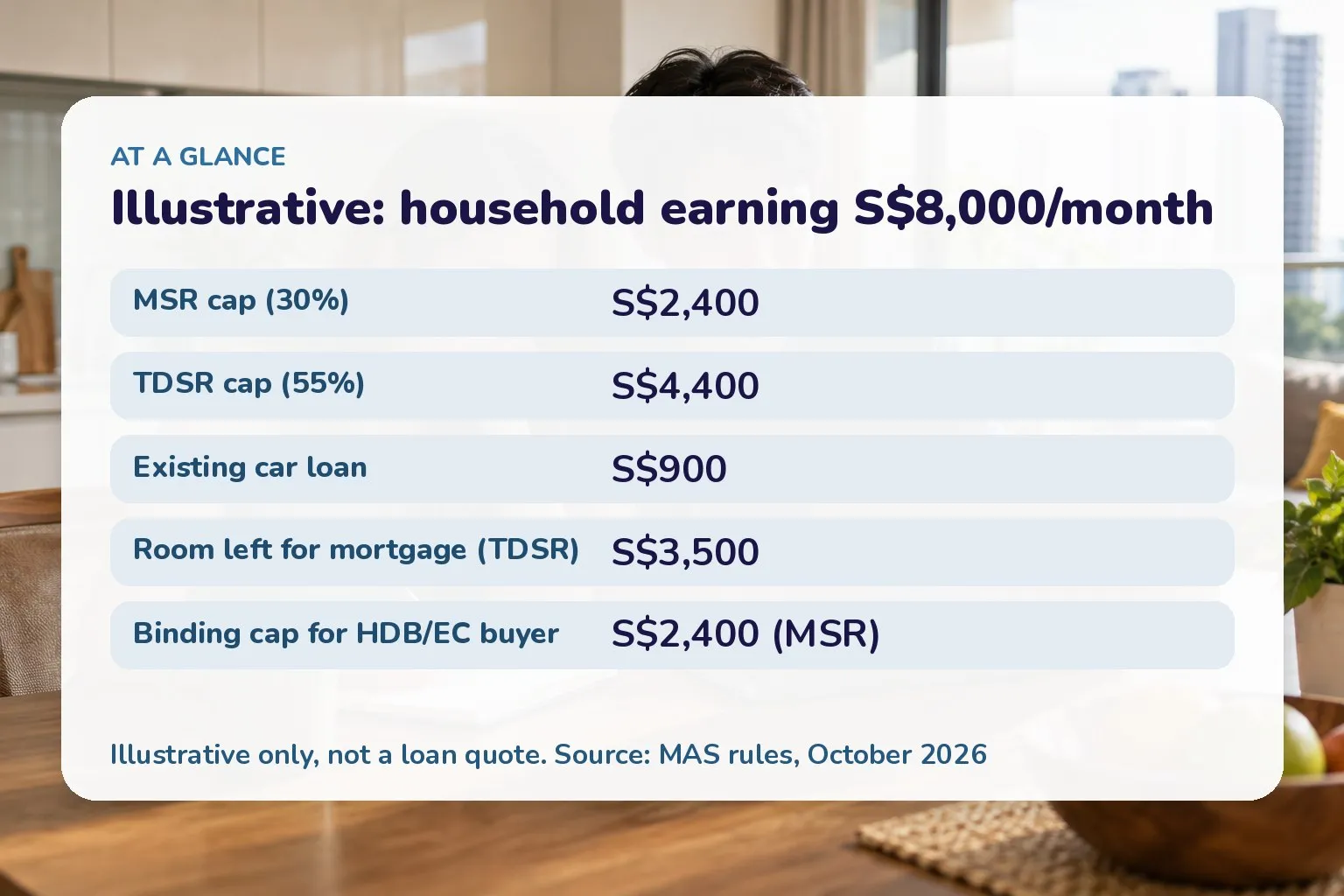
For HDB/EC buyers the lower MSR ceiling usually decides the maximum loan.
Here the buyer is an HDB/EC household, so the mortgage repayment cannot exceed the lower of the two ceilings — S$2,400 under MSR. For a private home with no MSR, the S$3,500 TDSR figure would apply instead. These are illustrative figures, not a quote; actual loan size also depends on tenure, the stress rate and loan-to-value limits.
How this links to your loan type and deposit
TDSR/MSR set the repayment ceiling; separate loan-to-value (LTV) limits cap the loan at 75% of price or value for a first housing loan, with the rest as downpayment. Which loan you take also matters — compare the fixed HDB concessionary rate against bank packages in HDB loan vs bank loan.
Before you commit
- Clear or reduce other debts to free up TDSR room.
- Remember repayments are tested at the stress rate, not the teaser rate.
- Check your grant eligibility, which lowers the loan you need — see CPF housing grants.
- Confirm you meet the purchase rules in who can buy an HDB resale flat.
Related
General information, not financial advice. Figures are illustrative; check MAS and HDB for the current rules.
Sources
- Calculating TDSR for Property Loans — Monetary Authority of Singapore (as of October 2026)
- Rules for New Housing Loans: LTV Limits — Monetary Authority of Singapore (as of October 2026)
- Credit to Finance a Flat Purchase — Housing & Development Board (as of October 2026)