HDB Loan vs Bank Loan: Which Is Cheaper?
The HDB concessionary loan is fixed at 2.6% per year (0.1% above the CPF Ordinary Account rate) and needs no cash downpayment if you have enough CPF, but has an income ceiling. Bank loans can start lower but float with the market and need at least 5% of the price in cash. HDB loans suit stability; bank loans suit rate-chasers who can handle changes.
If you are buying an HDB flat, you usually choose between the HDB concessionary loan and a bank loan. The HDB loan is fixed at 2.6% and forgiving on cash; bank loans can be cheaper for a while but move with the market and need cash upfront. Here is the honest comparison.
At a glance
| HDB loan | Bank loan | |
|---|---|---|
| Interest rate | 2.6% fixed, pegged 0.1% above CPF OA rate | Bank-set: fixed-rate or SORA-pegged, varies |
| Rate stability | Stable, rarely changes | Can rise or fall; repricing after lock-in |
| Max loan (LTV) | Up to 75% of price/value | Up to 75% of price/value |
| Downpayment | 25% — no compulsory cash if enough CPF | 25% — at least 5% in cash, rest cash/CPF |
| Eligibility | Income ceiling + must include a citizen | No HDB income ceiling |
| Early repayment | No penalty | Often a penalty within the lock-in period |
| Who can use it | HDB flats only | HDB or private property |
Interest rate: stable vs potentially lower
The HDB loan rate is 2.6% per year, pegged at 0.1% above the CPF Ordinary Account (OA) rate (2.5%), so it only moves if the CPF OA rate changes — which is rare. That predictability is the HDB loan’s biggest draw.
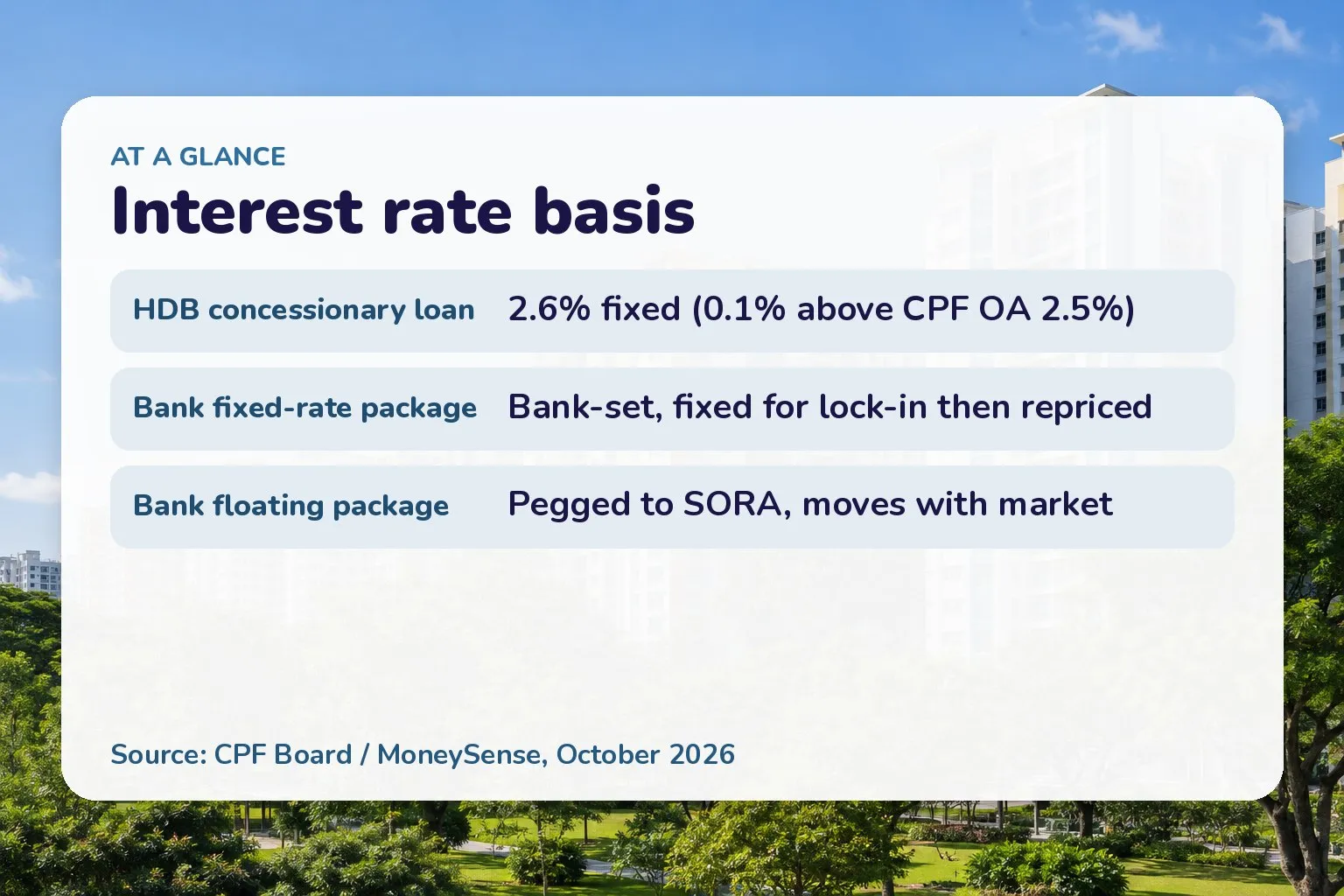
The HDB rate barely moves; bank rates can start lower but fluctuate.
Bank loans are priced by each bank as either a fixed-rate package (fixed for a lock-in period, then repriced) or a floating package pegged to SORA (the Singapore Overnight Rate Average). A bank package can be below 2.6% when rates are low, but it can also climb above it. You carry the interest-rate risk.
Downpayment: cash is the real difference
Both loans cap the loan at 75% of price or value for a first home loan, so the downpayment is 25% either way. The difference is how much must be cash:
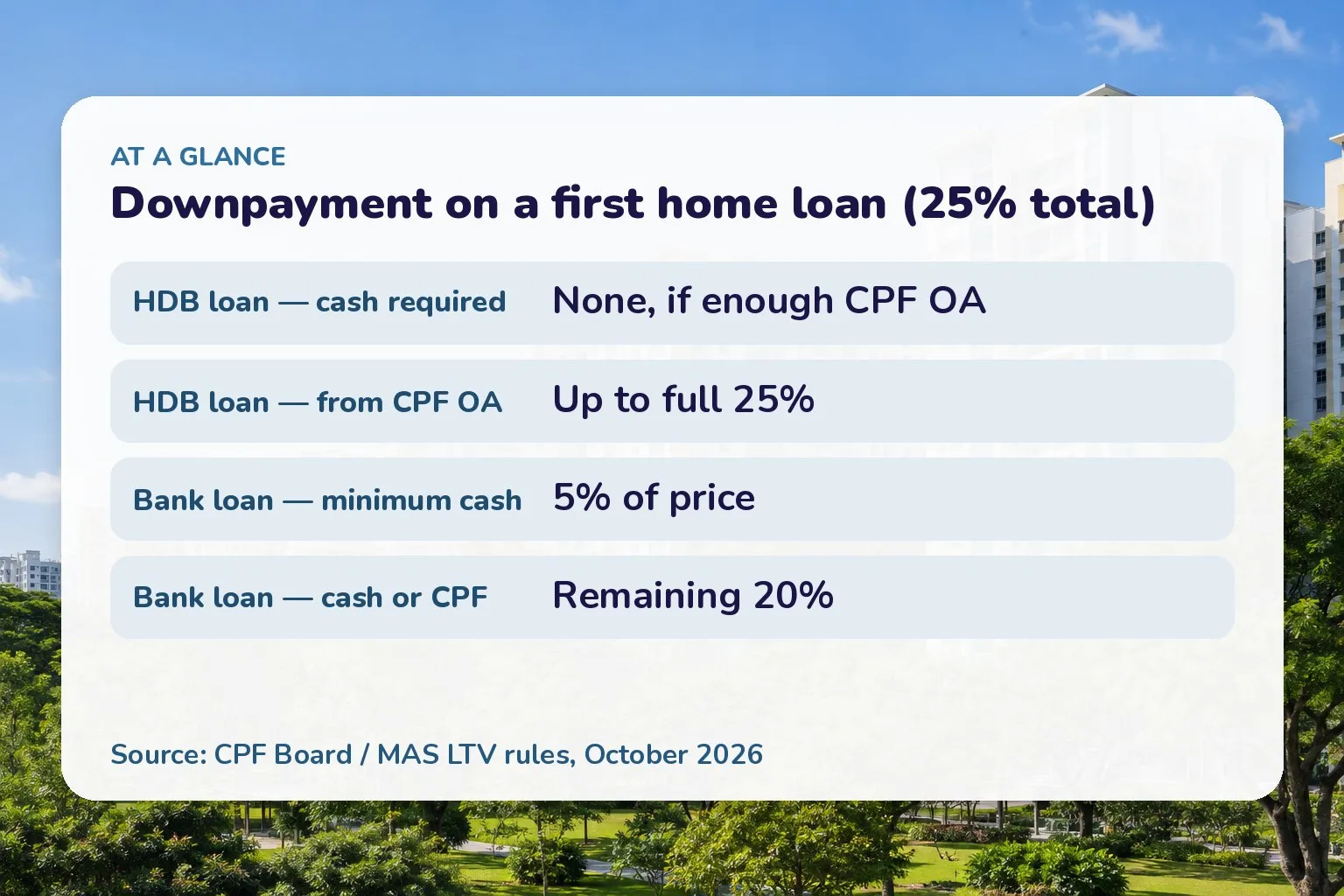
Both loans lend up to 75%; only the bank loan demands cash upfront.
- HDB loan: the 25% can be paid entirely from CPF OA if you have enough — no compulsory cash.
- Bank loan: at least 5% of the price must be in cash; the remaining 20% can be cash or CPF.
For buyers who are CPF-rich but cash-tight, the HDB loan removes a real hurdle.
Eligibility: the income ceiling
The HDB loan has conditions a bank loan does not:
- At least one buyer must be a Singapore Citizen.
- A monthly household income ceiling applies — from 24 August 2026, S$16,000 for families, S$8,000 for singles (35+) and S$24,000 for extended families.
- You need a valid HDB Flat Eligibility (HFE) letter.
Bank loans have no HDB income ceiling, so higher earners above the ceiling use a bank loan by default.
Flexibility and switching
You can refinance an HDB loan to a bank loan later, but you cannot switch back to an HDB loan once you leave it. HDB loans have no early-repayment penalty; bank loans usually charge one during the lock-in period. If you value the option to repay early or expect rates to fall, weigh that in.
So which is cheaper?
- Choose the HDB loan for rate stability, no cash downpayment and no penalties — ideal if you want certainty.
- Choose a bank loan if you can take a lower starting rate, have the 5% cash, and are comfortable monitoring and repricing when the lock-in ends.
Your repayment is also capped by the TDSR and MSR limits, and grants reduce the loan you need — check CPF housing grants. Compare current bank packages through a licensed comparison site; we do not recommend a specific product.
Related
General information, not financial advice. Rates and ceilings as of October 2026; check HDB, CPF and MAS for current figures.
Sources
- HDB loan or bank loan? 3 differences you should know — Central Provident Fund Board (as of October 2026)
- How home loans work — MoneySense (MAS) (as of October 2026)
- Rules for New Housing Loans: LTV Limits — Monetary Authority of Singapore (as of October 2026)
- Increase in Income Ceilings and Greater Support for Families with Children — Ministry of National Development (as of 22 August 2026)