How to Price Your HDB Resale Flat

Price your flat yourself from recent transacted prices of comparable flats on data.gov.sg — there is no official HDB valuation before you sell. The buyer requests the valuation only after you grant the Option to Purchase, and it caps their loan and CPF.
On this page10 sections · tap to jump
- 01The one rule that changes everything: no pre-sale valuation
- 02Three different numbers
- 03What moves your flat’s value
- 04A four-step pricing method
- 05Cash Over Valuation: the gap you price around
- 06How the Request for Value works
- 07What a price cut really costs you
- 08Reading the market in 2026
- 09Where the data lives
- 10FAQ
Pricing an HDB resale flat is not guesswork, and it is not something HDB does for you up front. You set the price from the same raw material a professional valuer uses — recent transacted prices of comparable flats, published free on data.gov.sg — and you do it before any official valuation exists. Get the number right and the sale completes; set it off stale or wishful comparisons and the valuation will not support the buyer’s financing. This guide shows how to build a defensible price and how the valuation and Cash Over Valuation fit around it.
The one rule that changes everything: no pre-sale valuation
There is no official HDB valuation you can obtain before selling. Since March 2014, HDB flipped the sequence: buyer and seller agree a price first, the seller grants the Option to Purchase (OTP), and only then can the buyer ask HDB for a valuation. HDB’s own selling process confirms Step 1 is “Negotiate and agree on the resale price,” and it points sellers to recent transacted prices to do so.
That means you are negotiating the largest sale of your life without an official number to anchor to. Your only defence is research.
Three different numbers
Sellers lose money by confusing three things:
- Asking price — what you hope to get. A marketing figure, usually set above the market.
- Agreed price — what a willing buyer and willing seller shake hands on. The real market price.
- Valuation — an independent assessment HDB’s appointed valuer produces after the OTP, which sets how much loan and CPF the buyer may use.
Your job is to make the asking price pull in buyers, and the agreed price land close to what the eventual valuation will support.
What moves your flat’s value
A valuer benchmarks your flat against recent sales of similar units, then adjusts. In rough order of how much they matter:
- Recent comparables in your block or precinct. Two or three recent sales of the same flat type nearby set your band. This is the anchor.
- Remaining lease. A newly-MOP flat with ~90+ years left is worth materially more than a nearby older flat with ~60 years — short leases also tighten the buyer’s CPF use and loan tenure.
- Storey and aspect. A high floor in the same stack commands a premium over a low one; an unblocked or greenery-facing unit adds more.
- Flat type, size and layout.
- Renovation condition. Sellers overrate this. A costly renovation typically moves the valuation only modestly — it helps speed of sale more than the number.
A four-step pricing method
Step 1 — Build the real comp set. On data.gov.sg, pull the HDB resale transactions dataset (it runs from January 2017 onwards, searchable by town, flat type, block and street). Filter to your block and surrounding blocks, the same flat type, last 6 months. HDB notes resale prices there “should be taken as indicative only,” so you are building a range, not a single truth.
Step 2 — Adjust like a valuer. Start from the comps and adjust for storey (a few thousand dollars per floor in younger estates is a common rule of thumb), view and orientation, corner versus corridor, and the lease difference versus each comparable. Be strict — the valuer will be.
Step 3 — Set the ask a little above your defensible estimate. Leave room to negotiate down to a number the valuation can support, without pricing so high that you filter out every financed buyer. The first weeks of a listing draw most of the serious interest.
Step 4 — Decide your Cash Over Valuation posture. If your unit is genuinely rare (high floor, unblocked, long lease), you can hold for a cash-strong buyer. If it is an ordinary stack in a soft market, price to your valuation estimate and win on speed.
Cash Over Valuation: the gap you price around
Once the OTP is granted and the buyer gets the valuation, any amount the agreed price exceeds the valuation is Cash Over Valuation (COV). It matters because of one hard rule: a buyer’s CPF savings and housing loan can both be used only up to the valuation, never the agreed price. So COV must be paid in cash, on top of the downpayment.
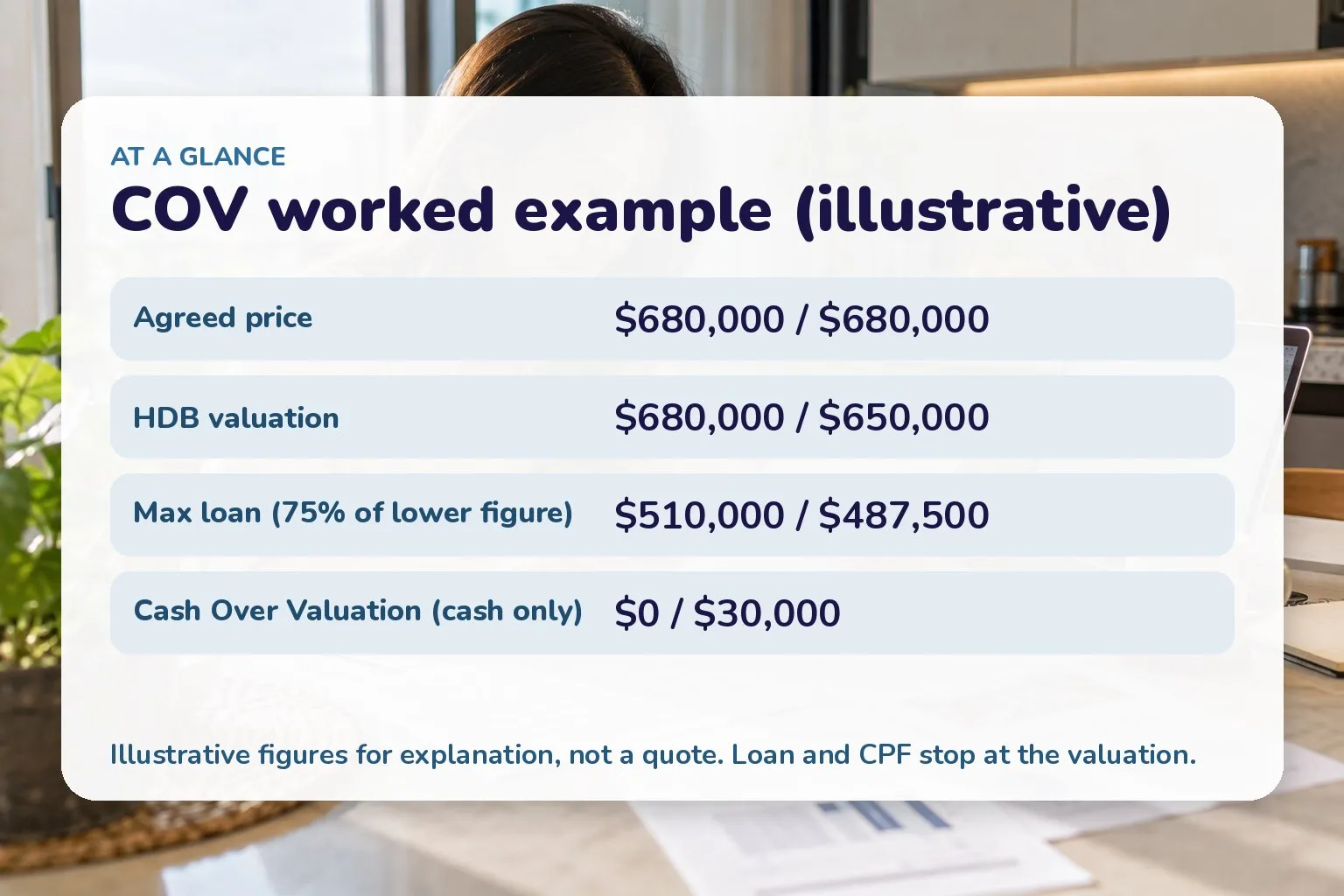
Illustrative only — figures for explanation, not a quote.
Valuation also sets the floor for the buyer’s Buyer’s Stamp Duty: IRAS charges BSD on the higher of the purchase price or the market value, with residential rates tiered from 1% on the first $180,000 up to 6% above $3,000,000.
How the Request for Value works
The valuation process is the buyer’s to run, not yours:
- Who and when: a buyer using CPF or a housing loan must submit a Request for Value to HDB, with page 1 of the OTP, by the next working day after the Option Date. A buyer paying fully in cash does not need one at all.
- Cost: about $120 including GST.
- Inspection: you must let HDB’s assigned valuer inspect the flat within 3 working days of HDB’s notification.
- Outcome: typically ready in about 10 working days, valid for 3 months — the resale application must be submitted within that window.
- One per OTP: HDB accepts only one Request for Value per flat while an OTP is live, so letting a deal lapse to “retry” the number resets everything.
Because the buyer controls this, as a seller you often first learn the valuation when the buyer’s agent calls to renegotiate. Pricing realistically up front avoids that call.
What a price cut really costs you
If the valuation comes in low and you cut the price, that reduction lands entirely on your cash proceeds. On completion the sale price first repays your outstanding loan, then refunds your CPF principal plus accrued interest to your Ordinary Account — both fixed amounts — and only the remainder is cash in hand. See how the payout stacks up in our guide to the HDB selling process and fees. Every dollar you concede comes off that final cash line, so model the cash impact before you agree to drop the price.
Reading the market in 2026
Price to the market you are in, not last year’s. The official HDB Resale Price Index (base 1Q2009 = 100) stood at 202.5 in Q3 2026, down 0.1% on the previous quarter — the index slipped 0.1% in Q1 and 0.3% in Q2, so it has drifted softly lower through 2026 after 2.9% growth in 2025. A falling index does not mean cheap flats everywhere; prices have held or risen in central and mature towns while easing in parts of the heartlands and for shorter-lease flats. That split is exactly why your own block’s recent comps matter more than the headline index.
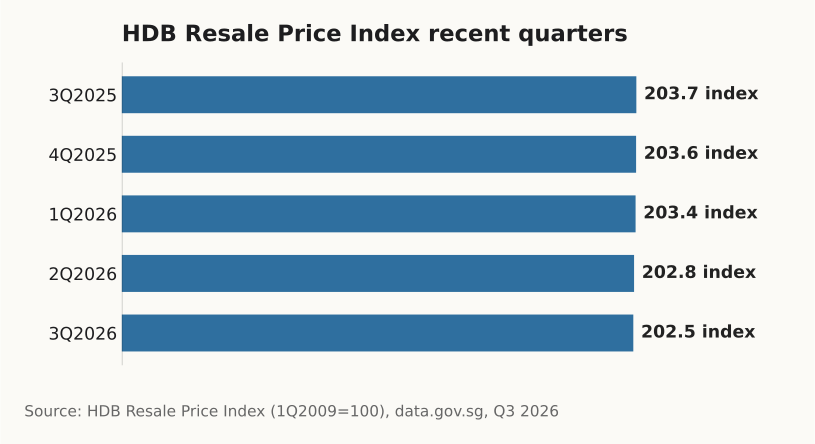
The official resale price index drifted softly lower through 2026 (base 1Q2009 = 100).
Where the data lives
- data.gov.sg — Resale Flat Prices (Jan 2017 onwards): every registered resale transaction by month, town, flat type, block, storey range, floor area, lease commencement and remaining lease.
- data.gov.sg — HDB Resale Price Index (quarterly): the official market benchmark.
- HDB Resale Statistics: median resale prices by town and flat type, and resale applications registered.
Build your estimate from these first; portal tools are a cross-check, not the anchor.
FAQ
Can I ask HDB for a valuation before I list? No. The Request for Value only happens after a buyer has your OTP. Estimate it yourself from recent transacted prices.
My neighbour sold high last year — can I match it? Only if recent, comparable sales still support it. A single older or higher-floor sale is not your valuation; the valuer uses the last few months of like-for-like deals.
Does a $50,000 renovation add $50,000 to the value? No. Renovation is weighted lightly in valuation; it tends to speed up a sale more than lift the number.
What if the valuation is far below the agreed price? The buyer can pay the COV in cash, you can renegotiate (a new OTP triggers a fresh valuation, which can come back lower), or the OTP lapses. There is no appeal to simply raise the figure.
Related
- Selling your HDB flat: process and fees
- Minimum Occupation Period (MOP): how it works
- HDB resale buying process, step by step
- The real cost of buying an HDB flat
General information using official data, not financial or property advice. Figures and the Resale Price Index change — check data.gov.sg and HDB for current numbers. We do not represent buyers or sellers.
Sources
- Resale Flat Prices (Based on Registration Date), From Jan 2017 onwards — data.gov.sg / Housing & Development Board (as of October 2026)
- HDB Resale Price Index (1Q2009 = 100), Quarterly — data.gov.sg / Housing & Development Board (as of October 2026)
- Option to Purchase When Selling a Flat — Housing & Development Board (as of October 2026)
- Buying an HDB flat (Buyer) — Request for Value — Council for Estate Agencies (as of October 2026)
- Using Your CPF to Buy a Home — Central Provident Fund Board (as of October 2026)
- Buyer's Stamp Duty (for Property) — Inland Revenue Authority of Singapore (as of October 2026)
- Resale Statistics (median prices, RPI) — Housing & Development Board (as of October 2026)