Proximity Housing Grant Explained
The Proximity Housing Grant gives resale HDB buyers S$30,000 (families) or S$15,000 (singles) to live with their parents or child, and S$20,000 or S$10,000 to live within 4km of them. There is no income ceiling.
On this page11 sections · tap to jump
- 01How much the PHG is worth
- 02Living with vs living near
- 03The 4km rule and how to check it
- 04Who counts as family
- 05Resale only — and the BTO alternative
- 06No income ceiling, and second-timers qualify
- 07Conditions after you buy
- 08Seniors right-sizing near family
- 09How to apply and how it is paid
- 10Who is not eligible
- 11Worked example
The Proximity Housing Grant (PHG) is the one CPF housing grant with a social, rather than a financial, test: it pays you to buy a resale flat close to your parents or your child. It is also the most widely available grant, because it ignores both your income and whether you have used housing subsidies before. This guide covers exactly how much it is worth, the 4km rule and how to check it, who counts as family, and the conditions you must keep after moving in.
For how the PHG stacks with the two income-tested grants, see CPF housing grants: eligibility and amounts.
How much the PHG is worth
The amount turns on two things: whether you are a family or a single buyer, and whether you move in with your parents or child or simply near them.
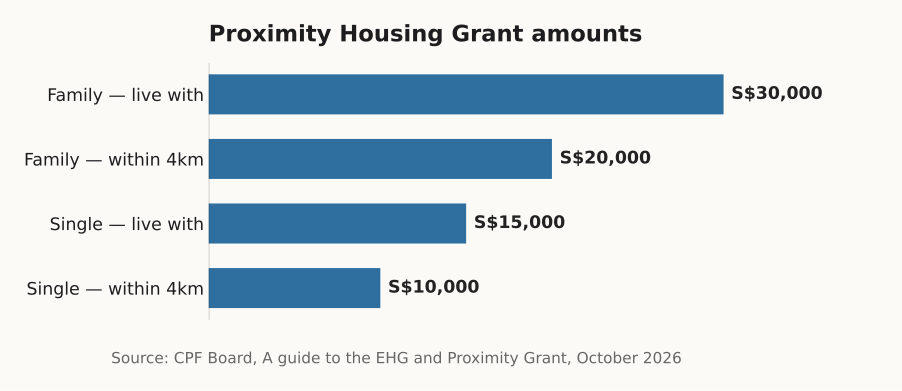
Proximity Housing Grant amounts by household type and arrangement.
| Buyer | Live with parents/child | Live near (within 4km) |
|---|---|---|
| Married couples and families | S$30,000 | S$20,000 |
| Single citizens | S$15,000 | S$10,000 |
Source: CPF Board, A guide to the EHG and Proximity Grant, October 2026.
Living together is worth S$10,000 more than living nearby in every case, which reflects the scheme’s aim — supporting multi-generational households, not just families in the same town.
Living with vs living near
These are two different conditions, each with its own proof:
- Living with your parents or child means they move into the resale flat you are buying. They must be listed in the flat application as co-applicants or essential occupiers, and they must physically occupy the flat throughout the minimum occupation period (MOP). Their names cannot be removed during that period.
- Living near means your parents or child keep their own home — an HDB flat or private residential property — within 4km of your resale flat. If they do not own that home, it has to be owner-occupied by immediate family: a child or adopted child, a parent or parent-in-law, or a sibling.
The 4km rule and how to check it
For the “live near” grant, the only distance that counts is HDB’s own measurement between your resale flat and your relative’s home — not the drive time, the MRT ride, or whether you are in the same town. In practice HDB measures a straight line between the two addresses, so a flat that is a 20-minute drive away can still qualify, while one that feels close can fall just outside.
The proximity you rely on at purchase is not a one-off check: it has to be observed during the MOP that follows (see below).
Who counts as family
The PHG is built around parents and children, including a married child, so that grandparents and grandchildren can live close together. Key rules on who qualifies you:
- The parent(s) or child who help you qualify must be a Singapore Citizen or Singapore Permanent Resident.
- A single buyer counting on a parent or child must generally be aged 35 or above (21+ if buying with a non-resident spouse).
- For the “live near” grant, if your relative does not own their home, it must be owner-occupied by immediate family — a child or adopted child, parent or in-law, or sibling.
What flat you can buy with the grant also depends on your household:
| Household | Flat type with PHG |
|---|---|
| Married couples / families | Any resale flat |
| Single citizen living near | 2- to 5-room resale flat |
| Single living with parents/child, or buying with a non-resident spouse | Any resale flat |
Source: CPF Board, October 2026.
Resale only — and the BTO alternative
The PHG exists only on the resale market. You cannot receive it on a new BTO or Sale of Balance flat. That is deliberate: for a new flat, HDB rewards proximity through priority in the ballot instead of cash.
- The Married Child Priority Scheme gives better ballot chances to married children (and their parents) applying for a flat to live with or near each other.
- The Senior Priority Scheme does the same for seniors aged 55+ buying a 2-room Flexi flat near a married child.
In both schemes, “near” uses the same 4km idea — your chosen project must have its nearest block within 4km of the relative’s home. So if you are set on a new flat, you trade the PHG cash for a higher chance of being balloted; on resale, you take the grant.
No income ceiling, and second-timers qualify
Two features make the PHG the easiest housing grant to qualify for:
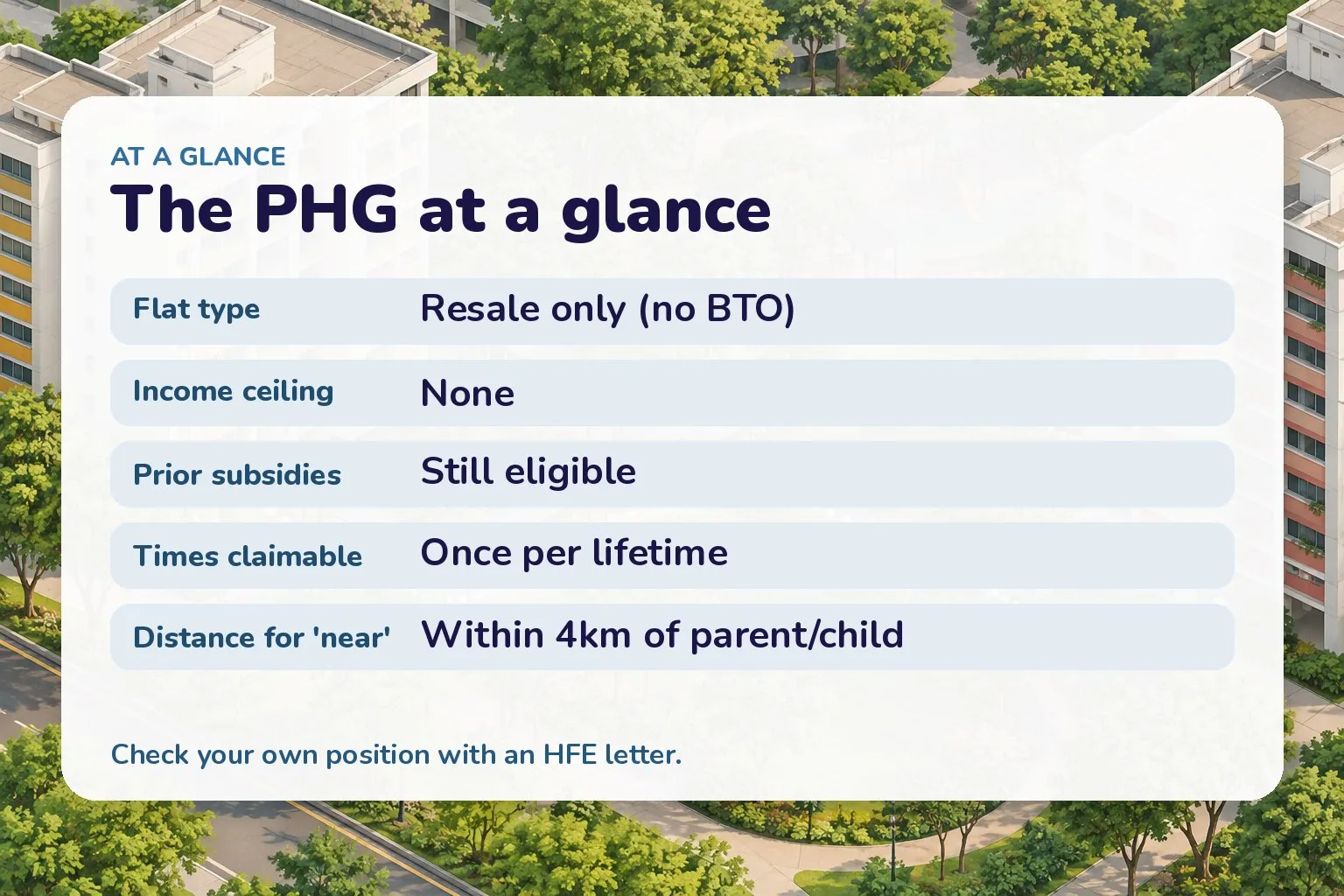
The Proximity Housing Grant at a glance.
- No income ceiling. Unlike the Enhanced CPF Housing Grant (capped at S$9,000 average monthly household income) or the CPF Housing Grant (S$16,000 for families from 24 August 2026), the PHG has no income test at all. A high earner who misses every other grant can still receive it.
- Prior subsidies do not disqualify you. HDB gives the PHG to eligible households “regardless of whether they had enjoyed housing subsidies before.” So a second-timer who already used the CPF Housing Grant on an earlier flat can still claim the PHG on a resale purchase near family.
Conditions after you buy
The grant is not just about where you buy — it is about keeping the arrangement:
- If you took the live-with grant, the parent or child must remain on the application and occupy the flat for the whole MOP; their names cannot be removed.
- If you took the live-near grant, your relative must keep observing the 4km proximity during the MOP after purchase.
- If your relative moves out or away during the MOP in a way that breaks the condition, HDB can require the grant to be refunded — so this is not a one-time box to tick at completion.
Seniors right-sizing near family
The PHG is not only for younger buyers. A senior who sells a larger home and buys a smaller resale flat within 4km of their married child’s HDB flat or private property can claim it too, as part of right-sizing closer to family. Seniors should check this alongside the other right-sizing support (such as the Silver Housing Bonus) when planning the move.
How to apply and how it is paid
- Apply for an HDB Flat Eligibility (HFE) letter through the HDB Flat Portal before you commit to a flat. It confirms upfront whether you qualify for the PHG and other grants, and how large an HDB loan you can take.
- Shortlist resale flats and, for a “live near” claim, check the 4km distance for each block.
- Apply for the grant when you submit your resale application, naming the parents or child you rely on.
Like the other CPF housing grants, the PHG is credited to the buyers’ CPF Ordinary Account to offset the flat price or reduce the loan — it is not paid out as cash.
Who is not eligible
Worked example
Related
- CPF housing grants: eligibility and amounts
- Buying an HDB flat as a single
- Who can buy an HDB resale flat?
- HDB resale buying process step by step
General information, not financial or property advice. Grant rules change — check HDB and the CPF Board for the current figures when you apply.
Sources
- A guide to the Enhanced CPF Housing Grant and Proximity Grant — Central Provident Fund Board (as of October 2026)
- Proximity Housing Grant for Families Buying Resale Flats — Housing & Development Board (as of October 2026)
- Proximity Housing Grant (Singles) — SupportGoWhere — Government of Singapore (SupportGoWhere) (as of October 2026)
- Priority Schemes for new flats — Housing & Development Board (as of October 2026)
- 3 retirement housing options for you — Central Provident Fund Board (as of October 2026)
- CPF Housing Grants for HDB Flat Buyers (MyNiceHome) — Housing & Development Board (MyNiceHome) (as of October 2026)