Tenancy Agreement and Deposit Explained

A tenancy agreement sets out the rent, term, deposit and each party's responsibilities. The security deposit is not capped by law; the market norm is one month's rent per year of lease. Lease stamp duty is payable to IRAS at 0.4% of the total rent for leases of up to four years, usually within 14 days of signing, and is typically paid by the tenant.
Before you move in, two documents decide the money: the tenancy agreement (TA) and the stamp certificate. The TA sets the rent, term and deposit; IRAS charges lease stamp duty at 0.4% of the total rent. Here is how both work.
What the tenancy agreement covers
The TA is the binding contract between landlord and tenant. A standard one states:
- Rent and the lease term (commonly one or two years).
- The security deposit and when it is returned.
- The diplomatic/break clause, if any, and the minimum stay before it can be used.
- Repair responsibilities — typically a minor-repair cap the tenant bears per item, with the landlord covering larger items and fair wear and tear.
- Who pays the stamp duty (usually the tenant).
Many rentals start with a Letter of Intent (LOI) and a good-faith deposit, which is then counted toward the security deposit or first month’s rent when the TA is signed.
The security deposit
Singapore has no law capping a rental deposit — it is a contract term. The settled market convention is:
- One year lease → one month’s rent as deposit.
- Two year lease → two months’ rent.
The deposit is held against damage beyond fair wear and tear and unpaid bills, and is usually returned within about two weeks of the lease ending, less any agreed deductions. Record the flat’s condition (photos, an inventory) at move-in to avoid disputes later.
Lease stamp duty: 0.4% of total rent
Stamp duty on a lease is payable to IRAS. For a lease of up to four years, it is:
0.4% of the total rent over the lease term.
For a lease longer than four years (or with an indefinite term), it is 0.4% of four times the average annual rent. Stamp duty is normally paid within 14 days of signing the agreement in Singapore, and the TA usually makes the tenant liable — though both parties should keep the stamped copy.
Worked example
| Figures | |
|---|---|
| Monthly rent | S$3,000 |
| Lease term | 2 years (24 months) |
| Total rent | S$72,000 |
| Lease stamp duty (0.4%) | S$288 |
| Security deposit (2 months) | S$6,000 |
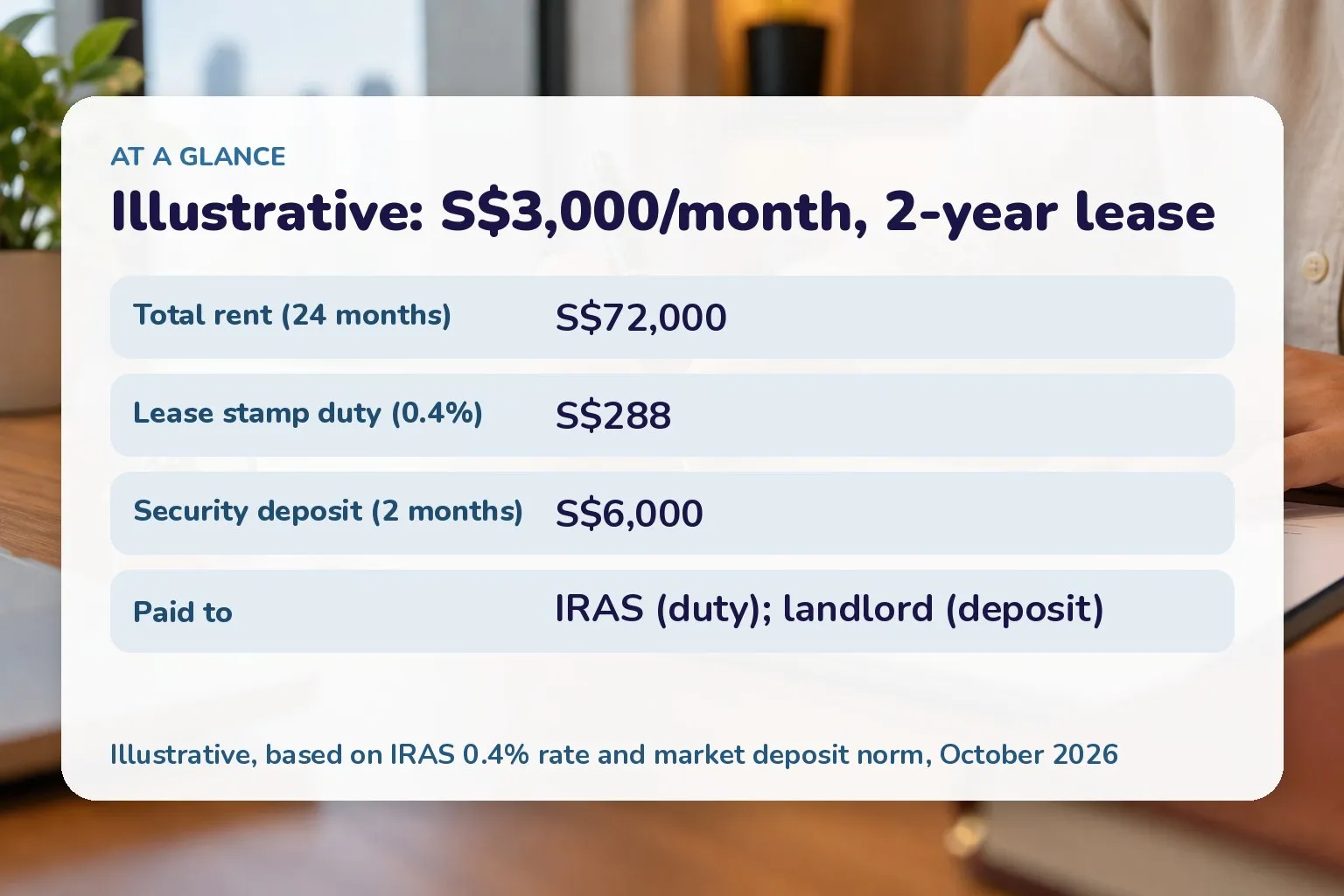
Stamp duty is 0.4% of total rent for leases up to four years.
So on a two-year lease at S$3,000/month, expect roughly S$288 in stamp duty and a S$6,000 deposit on top of your first month’s rent. These are illustrative figures based on IRAS’s 0.4% rate and the market deposit norm; your actual costs follow your TA.
Before you sign
- Read the repair clause and any break clause carefully.
- Agree the deposit amount and the return timeline in writing.
- Budget for stamp duty and pay it on time to avoid a penalty.
- If it is an HDB flat, check it is a properly approved rental — see renting an HDB flat.
Related
General information, not legal or tax advice. Confirm stamp duty with IRAS and read your tenancy agreement in full.
Sources
- Renting a Property (lease stamp duty rates and computation) — Inland Revenue Authority of Singapore (as of October 2026)
- Who Should Pay Stamp Duty — Inland Revenue Authority of Singapore (as of October 2026)