Seller's Stamp Duty (SSD) in Singapore Explained
Seller's Stamp Duty is a tax you pay for selling a residential property within four years of buying it, for purchases made on or after 4 July 2025. Rates run 16%, 12%, 8% then 4% by holding year, reaching 0% after four years.
On this page9 sections · tap to jump
Sell a home too soon after buying it and the taxman takes a slice. That slice is Seller’s Stamp Duty (SSD) — a cooling measure aimed at short-term property flipping. Since 4 July 2025 the rules are tougher than they had been for years: the holding period is back to four years and every tier is four percentage points higher. This guide sets out who pays, the exact rates, how the duty is worked out, and the many cases where you owe nothing.
What Seller’s Stamp Duty is
SSD is a tax on disposing of a residential property within a set holding period after you acquired it. The Ministry of Finance describes it plainly: SSD “aims to discourage short-term speculative activity which could distort underlying prices of residential and industrial properties,” applied on the sale of a property within the holding period, “with lower rates in the later years.”
It has been part of the property-cooling toolkit since 2010. IRAS states that SSD “is payable on all residential properties and residential lands that are acquired on or after 20 Feb 2010 and disposed of within the holding period.” Buy and sell outside that window and no SSD arises — the tax is designed to fall only on quick exits.
Who pays — and why HDB flats rarely do
Anyone who sells a residential property inside the holding period is liable, whether an individual or a company. In practice, though, the burden falls overwhelmingly on private-property sellers and on sub-sale buyers who offload uncompleted units for a quick gain — the exact behaviour the 2025 tightening targeted. The Ministry of Finance noted “a significant increase in the sub-sale of units that have not been completed” as a reason for reverting to the four-year period.
HDB flat sellers are the big exception. Because a flat’s five-year Minimum Occupation Period must pass before you can sell on the open market, the SSD window has already closed by the time you are allowed to sell. The Ministry of Finance confirms the point: “The revised SSD will not affect HDB owners due to the Minimum Occupation Period for HDB flats.”
When the holding period starts
The holding period counts from your date of acquisition, not from completion or key collection. IRAS says this is normally the Date of Acceptance of the Option to Purchase (OTP), or the Date of the Sale and Purchase Agreement, or — for a new HDB flat — the Date of the Agreement for Lease.
That start date also decides which schedule applies to you. IRAS is explicit that an OTP accepted on or after 4 July 2025 falls under the revised rates: “If you exercise the OTP on or after 4 July 2025, you will be subjected to the revised SSD schedule… There will be no transition period.”
Two special cases change the start date rather than the rate. For a property received by inheritance, the acquisition date is “the date the interest was acquired by the deceased” — so an inherited home is usually well past any holding period. For a transfer on divorce that meets the Matrimonial Proceedings remission rules, it is the later of the marriage date or the date the transferor first acquired the interest.
Current SSD rates (bought on or after 4 July 2025)
For a residential property purchased on or after 4 July 2025, SSD runs across a four-year holding period:
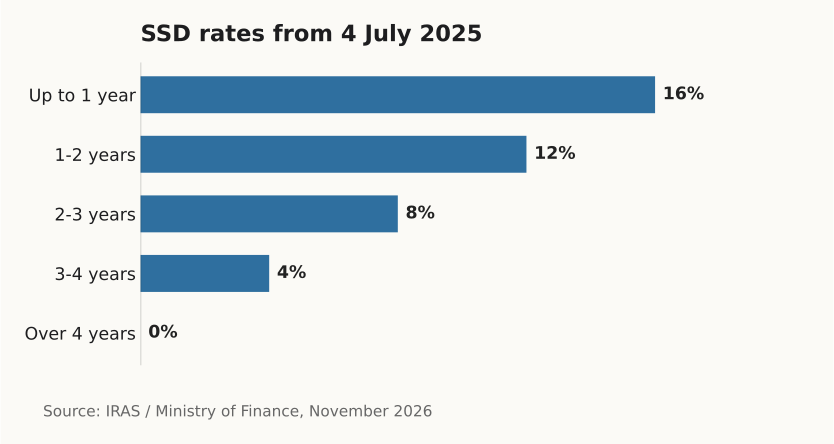
Seller’s Stamp Duty rates by holding period, purchases on or after 4 July 2025. Source: IRAS / Ministry of Finance, as of November 2026.
| Holding period | SSD rate (from 4 July 2025) |
|---|---|
| Up to 1 year | 16% |
| More than 1 year, up to 2 years | 12% |
| More than 2 years, up to 3 years | 8% |
| More than 3 years, up to 4 years | 4% |
| More than 4 years | No SSD |
The structure is deliberately front-loaded: sell in the first year and you lose 16% of the price; hold past the fourth anniversary and the duty disappears. This reverses the 2017 relaxation — as the Ministry of Finance put it, “In 2017, this period was reduced from four to three years, and the SSD rates were also reduced by four percentage points,” and the Government has now reverted to the pre-2017 position.
If you bought before 4 July 2025
Your purchase date fixes your schedule for the whole holding period. A property bought between 11 March 2017 and 3 July 2025 keeps the older, lighter three-year schedule:
| Holding period | SSD rate (11 Mar 2017 – 3 Jul 2025) |
|---|---|
| Up to 1 year | 12% |
| More than 1 year, up to 2 years | 8% |
| More than 2 years, up to 3 years | 4% |
| More than 3 years | No SSD |
Older bands exist too — homes bought between 14 January 2011 and 10 March 2017 face up to 16% over a four-year period, and anything acquired before 20 February 2010 is outside SSD altogether. If your purchase straddles these dates, check the exact band on the IRAS page before you assume a figure.
How SSD is worked out
The sum is simple once you know your rate. IRAS computes SSD “by applying the requisite SSD rate on the higher of the selling price or the market value of the residential property as at the date of sale,” rounded down to the nearest dollar, subject to a minimum duty of $1.
That example shows why the duty is a genuine brake: on a quick, profitable exit it can erase the entire gain and then some. Before committing to sell early, weigh the SSD against the reasons for selling, and remember it sits on top of other selling costs and any property tax still due for the year.
Exemptions and remissions
Several sellers owe nothing even inside the holding period, and IRAS requires no application for these. The main exemptions include:
- Licensed housing developers selling properties they developed, and public authorities (such as HDB and JTC) carrying out their duties.
- Owners whose property is acquired by the Government under the Land Acquisition Act.
- Individuals adjudged bankrupt who must dispose of their property as a result, and companies disposing on involuntary winding up.
- Foreigners required to sell under the Residential Property Act.
- Various HDB situations from 18 December 2015 onward — for example, someone who owns one HDB flat and inherits another and must dispose of one under HDB rules, or a couple who each own a flat and must give one up on marriage.
How and when to pay
SSD is a stamp duty, so it is stamped and paid through IRAS’s e-Stamping service on myTax Portal around the time the sale is executed. In a conveyancing sale your lawyer normally handles the stamping; the SSD falls due on the seller and is settled as part of completing the transaction. Keep proof of the purchase date (your OTP or agreement) handy, since it determines both whether SSD applies and which rate schedule you are on.
Frequently asked questions
Do I pay SSD when I sell my HDB flat? Almost never. You can only sell on the resale market after the five-year MOP, by which point the four-year SSD window has already closed. See selling an HDB flat for the actual process and costs.
Is SSD based on my profit? No. It is charged on the higher of the selling price or the market value — not on your gain — so you can owe SSD even on a sale that barely breaks even.
Does buying a second property trigger SSD? No. SSD is a selling tax. A second purchase instead attracts Additional Buyer’s Stamp Duty at the time you buy; SSD only arises if you later sell within the holding period.
What if I bought before the July 2025 change? Your purchase date locks your schedule. A home bought between 11 March 2017 and 3 July 2025 keeps the three-year, 12/8/4% schedule even if you sell after the rules changed.
Related
- Selling an HDB flat: the process and costs
- The Minimum Occupation Period (MOP) explained
- Property tax in Singapore explained
- How to price your resale flat
General information, not tax or legal advice. Confirm your own SSD rate and liability with IRAS or your conveyancing lawyer.
Sources
- Seller's Stamp Duty (SSD) for Residential Property — Inland Revenue Authority of Singapore (as of November 2026)
- Extension of the Holding Period of Seller's Stamp Duty and Higher SSD Rates for Residential Properties — Ministry of Finance (as of November 2026)
- Stamp Duty rates (quick links) — Inland Revenue Authority of Singapore (as of November 2026)
- Stamp Duty (policy overview) — Ministry of Finance (as of November 2026)