Property Tax in Singapore Explained
Property tax is an annual asset tax on property ownership: your home's Annual Value — its estimated yearly market rent — multiplied by a progressive rate. A home you live in is taxed at lower owner-occupier rates, starting at 0% on the first S$12,000 of Annual Value.
On this page12 sections · tap to jump
- 01What property tax actually is
- 02How the bill is worked out
- 03Annual Value: the number everything hangs on
- 04How to check your Annual Value
- 05Owner-occupier rates (the home you live in)
- 06If you rent it out or leave it vacant
- 07Why your bill changes year to year
- 08The 2026 property tax rebate
- 09When and how to pay
- 10Instalments and help paying
- 11Worked examples
- 12FAQ
Property tax is one of the few housing costs that never stops — you pay it every year you own a home, whether you live in it, rent it out or leave it empty. Yet most owners only glance at the bill each January. This guide explains exactly how that figure is built: the Annual Value behind it, the progressive rates that apply, the 2026 rebate, and the ways to pay. Every number here is the official IRAS or Ministry of Finance figure, dated.
What property tax actually is
Property tax in Singapore is an asset tax on property ownership, not a tax on rental income. It is levied on the fact that you own the property, “irrespective of whether the property is occupied or vacant.” So an owner who lives in the flat, an owner who rents it out, and an owner who leaves it empty are all liable — the rate just differs.
That also means it is separate from income tax. If you rent your place out, you pay income tax on the rent and property tax on ownership, but these are different taxes, and you may claim the property tax paid on a rented-out property as a deductible expense against the rental income.
How the bill is worked out
The formula is short:
Property tax payable = Annual Value × the property tax rate that applies to you.
Two things drive the number: your home’s Annual Value (AV), and whether it is taxed at the lower owner-occupier rates (you live in it) or the higher non-owner-occupier rates (rented out or vacant). Both rate scales are progressive — higher AV, higher marginal rate.
Annual Value: the number everything hangs on
The Annual Value is IRAS’s estimate of the yearly market rent your property could fetch, unfurnished — not what you actually paid for it and not what you earn. IRAS sets it by looking at the rents of similar, comparable properties nearby. As the official explainer puts it, if you own a five-room flat in Toa Payoh, IRAS “looks at similar five-room flats in Toa Payoh and how much they are rented out at” to determine the AV.
In setting a building’s AV, IRAS weighs the rentals of comparable properties in the vicinity, the property’s size, its location, its condition and other physical attributes. Because it is pegged to market rents, the AV is reviewed every year and can be revised up, down, or left unchanged depending on how comparable rents have moved.
How to check your Annual Value
You do not have to guess. As the owner, you can check your property’s current AV free using the “View Property Summary” digital service on IRAS’s myTax Portal with your Singpass. If you are not the owner — say you are researching a flat before buying — you can look up any property’s AV for S$2.50 per search via the “Check Annual Value of Property” service, which shows the current year and the past five years.
Owner-occupier rates (the home you live in)
A property you own and live in is taxed at the lower, concessionary owner-occupier tax rates, designed to encourage home ownership. The schedule below took effect on 1 January 2025, after Budget 2024 raised the first (0%) band from S$8,000 to S$12,000 of AV.
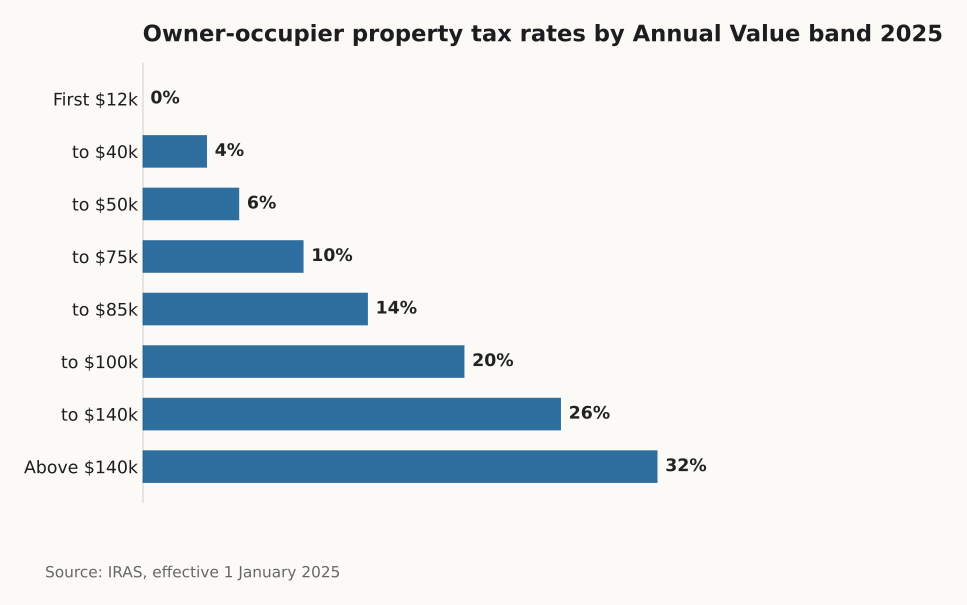
Owner-occupier residential property tax rates, by Annual Value band. Source: IRAS, effective 1 January 2025.
| Portion of Annual Value | Owner-occupier rate (from 1 Jan 2025) |
|---|---|
| First S$12,000 | 0% |
| Next S$28,000 (to S$40,000) | 4% |
| Next S$10,000 (to S$50,000) | 6% |
| Next S$25,000 (to S$75,000) | 10% |
| Next S$10,000 (to S$85,000) | 14% |
| Next S$15,000 (to S$100,000) | 20% |
| Next S$40,000 (to S$140,000) | 26% |
| Above S$140,000 | 32% |
Because the first S$12,000 of AV is taxed at 0%, all one- and two-room HDB flats continue to pay no property tax, and most other HDB flats are taxed only at the 4% marginal rate on the slice of AV above S$12,000. The concession is granted to only one property you own and occupy; a married couple can apply it to just one home even if they occupy two, whether owned jointly or separately.
For buyers, the owner-occupier rates apply automatically to purchasers of new or resale HDB and DBSS flats and new executive condominiums, and to Singapore Citizens or PRs who buy private residential property — provided neither you nor your spouse is already enjoying the concession on another home.
If you rent it out or leave it vacant
The moment a home stops being your residence, the concession goes. A rented-out or vacant home is taxed at the steeper non-owner-occupier residential rates (effective 1 January 2024):
| Portion of Annual Value | Non-owner-occupier rate (from 1 Jan 2024) |
|---|---|
| First S$30,000 | 12% |
| Next S$15,000 (to S$45,000) | 20% |
| Next S$15,000 (to S$60,000) | 28% |
| Above S$60,000 | 36% |
There is no relief for a vacant property — leaving it empty does not reduce the tax. And any other property (commercial or industrial) is taxed at a flat 10% of AV, with no owner-occupier concession even if you use it yourself.
Why your bill changes year to year
Three things move a bill: the AV (IRAS’s annual review), any change in use (you moved out and rented it, or moved back in), and changes to the rates or rebate announced at Budget. The rate bands themselves are stable — the owner-occupier scale has been fixed since 1 January 2025 — so year-to-year changes for most owner-occupiers come from the AV review and the size of that year’s rebate.
The 2026 property tax rebate
To cushion owners against rising AVs, the Government is giving a one-off rebate in 2026: 15% of the property tax payable for owner-occupied HDB flats, and 10%, capped at S$500, for owner-occupied private residential properties. It is applied automatically — offset against the tax in the 2026 bill issued from December 2025, with no application needed.
The rebate is smaller than 2025’s (which was 20% for HDB and 15% capped at S$1,000 for private homes, now lapsed). After the 2026 rebate, the Ministry of Finance says owner-occupiers in three-room and larger HDB flats will see an average increase of about S$2 to S$3 a month, while one- and two-room owner-occupiers continue to pay nothing. Half of private owner-occupiers will see an increase of under S$6 a month, with higher rises concentrated among higher-value homes.
When and how to pay
Property tax is payable yearly in advance. The 2026 bill is due on 31 January 2026. IRAS sends SMS or email reminders with the amount and your property tax reference number, and the bill is viewable on myTax Portal.
You can pay instantly by PayNow QR or AXS using your tax reference number, or by internet banking (which posts within three working days). For convenience, most owners put the bill on GIRO.
Instalments and help paying
GIRO gives you a one-time deduction or up to 12 interest-free monthly instalments — useful for spreading a larger private-property bill across the year.
There is also an Extended GIRO Scheme for retirees, offering up to 24 months of instalments. With effect from 1 January 2026, you qualify if you reside in the property (so it is on owner-occupier rates), your assessable income is not more than S$39,000, all owners are aged 65 or above, and there is outstanding property tax to pay.
Worked examples
These show the progressivity clearly: a modest-AV home pays nothing or a few hundred dollars, while a high-AV home climbs quickly through the bands.
FAQ
I own and occupy two homes. Can both get owner-occupier rates? No. The concession applies to only one home. A married couple can apply it to just one of the two, regardless of how each is owned.
Does property tax depend on what I paid for the flat? No. It is based on the Annual Value — the estimated market rent — not your purchase price or your outstanding loan.
If I rent out my property, am I taxed twice? No. Property tax (on ownership) and income tax (on rental income) are different taxes, and you can claim the property tax paid on a rented-out property as an expense against the rental income.
How far back can I claim owner-occupier rates if I forgot to apply? Refund claims for owner-occupier rates are limited to the five preceding years from the year you apply, so apply promptly.
Related
- The real cost of buying an HDB flat
- Private property vs HDB: the true cost
- Renting out an HDB flat: rules and costs
General information to help you understand your bill, not tax advice. Confirm your own figures with IRAS, including your current Annual Value on myTax Portal.
Sources
- Property Tax on Residential Property — Government of Singapore (as of October 2026)
- Property Tax Rates and Sample Calculations — Inland Revenue Authority of Singapore (as of October 2026)
- Lower Property Tax Rates for Owner-Occupied Residential Properties — Inland Revenue Authority of Singapore (as of October 2026)
- About Annual Value — Inland Revenue Authority of Singapore (as of October 2026)
- Property Tax Reliefs (2026 rebate) — Inland Revenue Authority of Singapore (as of October 2026)
- 2026 Property Tax Bill — Inland Revenue Authority of Singapore (as of October 2026)
- Government Will Grant One-Off Property Tax Rebate for All Owner-Occupied Residential Properties in 2026 — Ministry of Finance (as of October 2026)