Private Property vs HDB: The True Cost
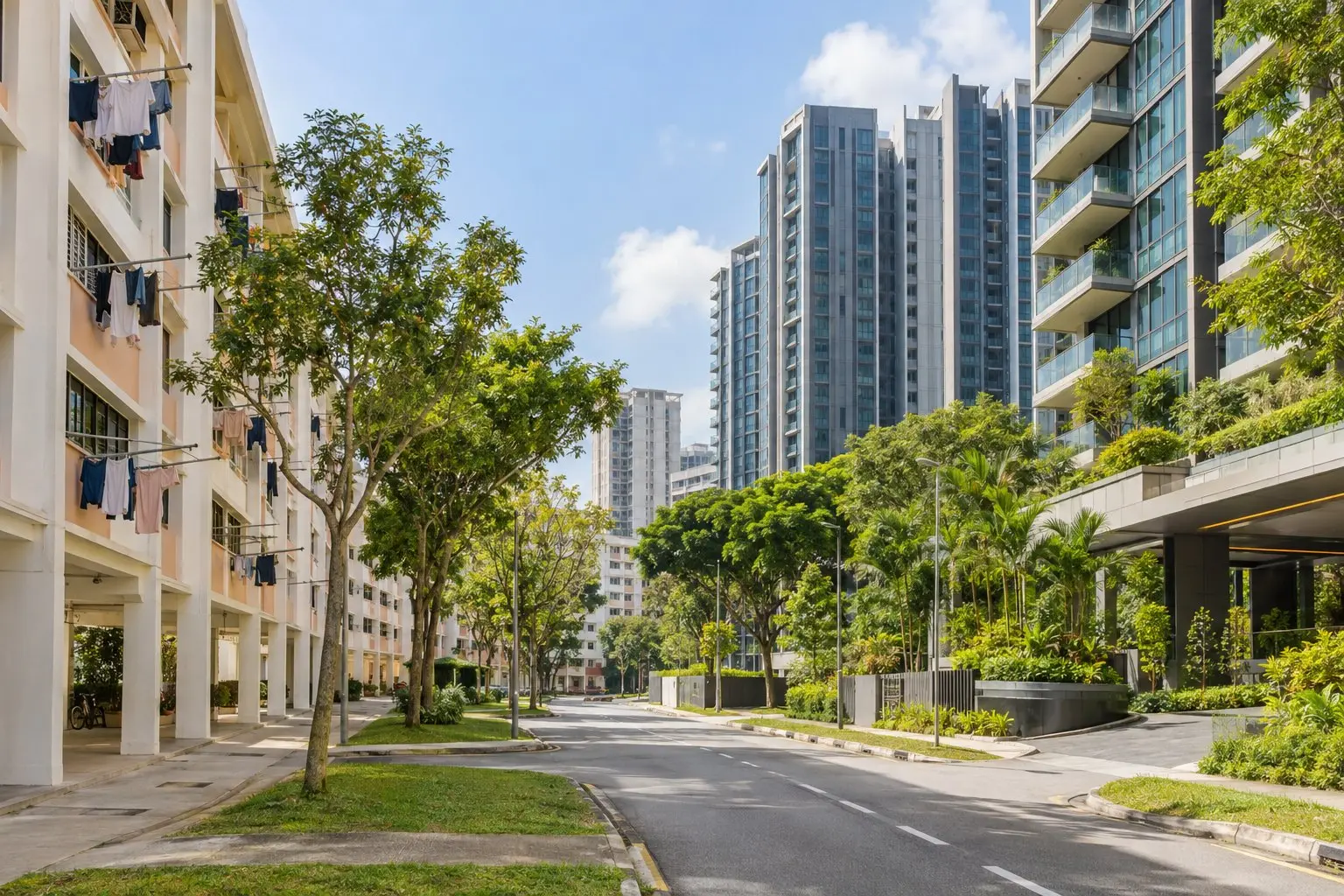
For a first-time Singapore-citizen household, an HDB flat is the cheaper home by a wide margin — a smaller cash outlay, no ABSD, up to S$120,000 in grants and low monthly charges. A private condo costs more upfront, in financing and in upkeep, but carries no eligibility rules.
On this page11 sections · tap to jump
- 01Quick verdict
- 02The cost gap in one table
- 03Upfront: downpayment, cash and loan type
- 04Stamp duty: the same BSD, very different ABSD
- 05How much you can borrow: MSR vs TDSR
- 06Grants: HDB has them, private doesn’t
- 07Holding costs: property tax and maintenance
- 08Eligibility and exit costs
- 09A worked comparison
- 10When HDB is the wrong choice
- 11FAQ
“Should we buy an HDB flat or stretch for a condo?” is really a question about cost — not just the sticker price, but the cash you need upfront, how much a lender will give you, the stamp duties, and what you pay every month for years afterwards. On every one of those, an HDB flat is cheaper. A private condo buys you freedom from eligibility rules and a bigger borrowing headroom, and you pay for both. This guide compares the two on the real, official numbers.
Quick verdict
The cost gap in one table
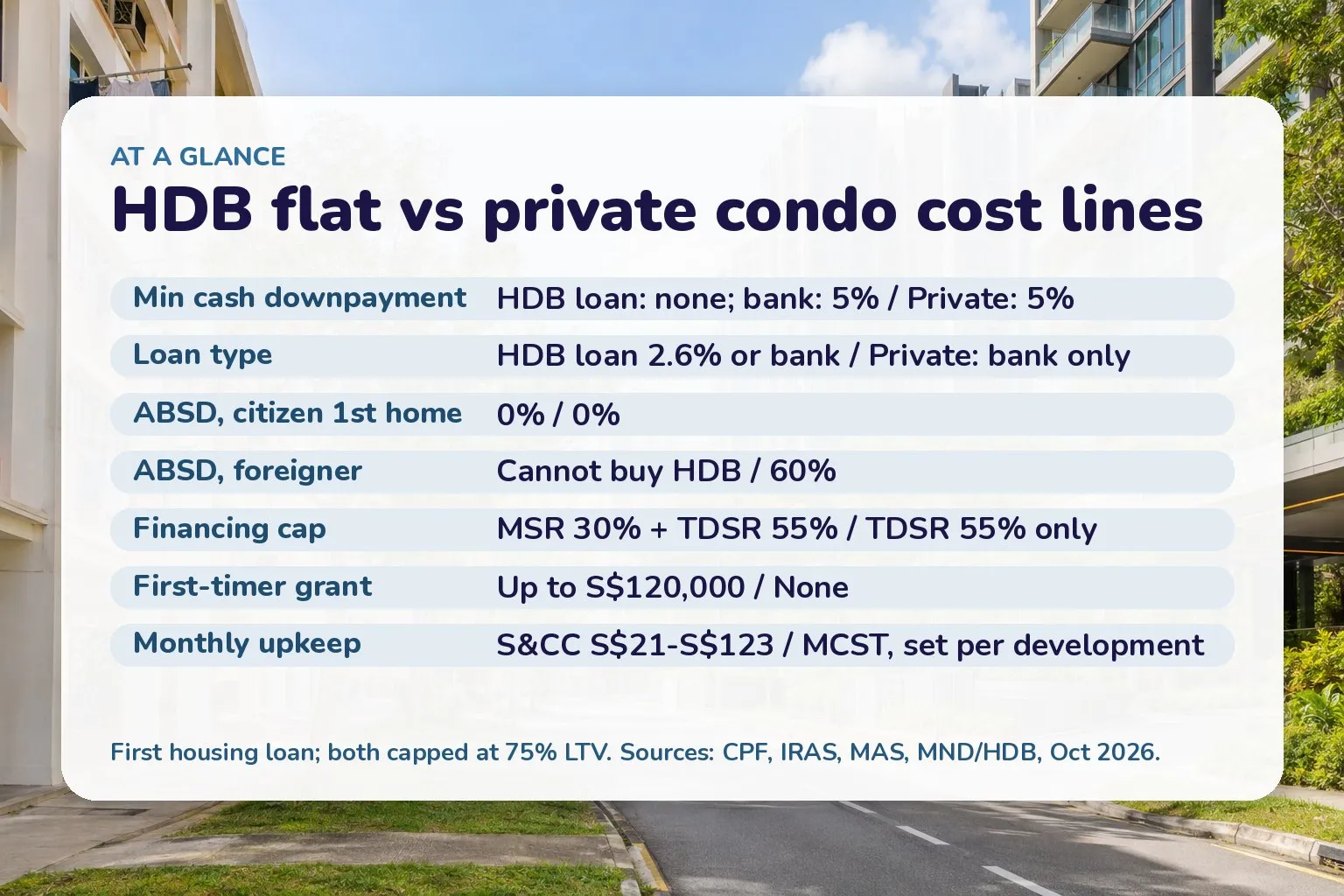
How an HDB flat and a private condo compare on the main cost lines
| Cost line | HDB flat | Private condo |
|---|---|---|
| Max loan (first home) | 75% LTV | 75% LTV |
| Minimum cash downpayment | None on an HDB loan (full CPF); 5% on a bank loan | 5% (bank loan only) |
| Loan type available | HDB loan (2.6%) or bank loan | Bank loan only |
| Buyer’s Stamp Duty | 1%–6% (tiered) | 1%–6% (tiered) |
| ABSD, citizen’s first home | 0% | 0% |
| ABSD, foreigner | Not eligible to buy | 60% |
| Financing ratios | MSR 30% + TDSR 55% (bank loan) | TDSR 55% only |
| First-timer grant | Up to S$120,000 (EHG) | None |
| Monthly upkeep | S&CC ≈ S$21–S$123 | MCST fee, set per development |
Upfront: downpayment, cash and loan type
Both an HDB flat and a private home are capped at a 75% loan-to-value (LTV) limit on a first housing loan, so each needs a 25% downpayment. The difference is how you can pay that 25%, and that is decided by the loan.
- HDB flat on an HDB concessionary loan: the 25% “can be paid in full using your CPF Ordinary Account” — there is no minimum cash requirement. For a buyer who is CPF-rich but cash-light, this is the gentlest entry.
- HDB flat on a bank loan: 25% down, of which at least 5% must be cash and the rest cash or CPF.
- Private condo: only a bank loan is available — HDB does not lend for private property — so the 5%-minimum-cash rule always applies. The 2.6% HDB concessionary rate is simply not on the table.
Stamp duty: the same BSD, very different ABSD
Buyer’s Stamp Duty (BSD) is identical for an HDB flat and a private home — the same tiered residential scale on the price or market value, whichever is higher: 1% on the first S$180,000, 2% on the next S$180,000, 3% on the next S$640,000, 4% on the next S$500,000, 5% on the next S$1,500,000 and 6% on the remainder.
The real divide is Additional Buyer’s Stamp Duty (ABSD):
| Buyer profile | 1st property | 2nd | 3rd+ |
|---|---|---|---|
| Singapore Citizen | 0% | 20% | 30% |
| Permanent Resident | 5% | 30% | 35% |
| Foreigner | 60% | 60% | 60% |
A Singapore citizen buying a first home — HDB or private — pays no ABSD, so on a first purchase ABSD is not what separates the two. It bites on anything beyond that: a citizen’s second property is 20%, a PR’s first is 5%, and any foreigner pays 60%. Because an HDB flat can only be bought by an eligible citizen-anchored household and never as a second residential property you already pair with another home, ABSD is overwhelmingly a private-property cost. A private condo, by contrast, has no eligibility scheme at all and is open to foreigners — who meet that 60% charge.
How much you can borrow: MSR vs TDSR
Lenders cap your loan against your income, and here the HDB side is more restrictive, which can lower the price you qualify for:
- A housing loan for an HDB flat (and a new EC from a developer) must pass the Mortgage Servicing Ratio (MSR): your housing instalment cannot exceed 30% of gross monthly income — and, on a bank loan, also the Total Debt Servicing Ratio (TDSR) of 55%.
- A private property loan is subject to TDSR only (55%) — there is no MSR.
So at the same income, a private buyer can usually direct more of their income toward the mortgage than an HDB buyer can. That cuts both ways: more borrowing headroom also means more debt. Work through the limits in TDSR and MSR limits explained before you shortlist.
Grants: HDB has them, private doesn’t
This is where the HDB cost advantage is largest. First-timer HDB households can receive CPF housing grants — the Enhanced CPF Housing Grant (EHG) reaches up to S$120,000 for families (S$60,000 for singles) on new and resale flats, paid into your CPF to offset the price. Resale buyers may stack further grants on top. Private condos attract no grant whatsoever. For an eligible first-timer, the grant alone can dwarf every fee on this page. See who qualifies in CPF housing grants: eligibility and amounts.
Holding costs: property tax and maintenance
The bills do not stop at completion.
Property tax uses the same owner-occupier rate scale for both — 0% on the first S$12,000 of Annual Value, then 4%, 6%, 10% and up to 32% — but a private home commands far higher market rents, so its Annual Value is much higher, pushing it into higher tax bands. A private owner therefore pays materially more property tax than an HDB owner for the equivalent “live-in” status. The 2026 rebate also favours HDB: 15% for owner-occupied HDB flats versus 10% capped at S$500 for private homes. The mechanics are in property tax in Singapore explained.
Monthly upkeep differs in both size and structure:
- An HDB flat pays Service & Conservancy Charges (S&CC) to the Town Council — standardised by flat type at roughly S$21 to S$123 a month.
- A private condo is run by a Management Corporation (MCST) under the Building Maintenance and Strata Management Act, which collects a monthly maintenance fee plus a sinking fund. There is no standardised figure — it is set per development by share value and the facilities on offer, and is typically several hundred dollars a month (a market estimate; check the specific development). Pools, gyms and security cost money to run.
Eligibility and exit costs
Two more differences shape the true cost:
- Eligibility. An HDB flat requires an eligible citizen-anchored household and comes with a minimum occupation period; a private condo has none of these rules. If you do not meet HDB’s rules, the “cheaper” option is not actually open to you — a real constraint, not a footnote.
- Exit. A private home sold within four years of buying (for homes bought on or after 4 July 2025) attracts Seller’s Stamp Duty of 16%, 12%, 8% then 4%; an HDB flat is governed instead by its occupation period, and a resale levy can apply if you later buy another subsidised flat.
A worked comparison
When HDB is the wrong choice
The HDB flat is the cheaper home, but it is the wrong pick if any of these apply: your household income is over the HDB ceiling; you are not a citizen-anchored household (a foreign spouse or a non-resident); you want to buy a second property or invest; or you need the freedom to rent out the whole home or sell without an occupation period. In those cases the private condo’s extra cost buys something you actually need — and the comparison tips the other way. If you are weighing an executive condominium as a middle path, see executive condo vs private condo.
FAQ
Is the condo always more expensive? On upfront cash, stamp duty beyond a first home, and monthly upkeep, yes. But if you are over the HDB income ceiling or not an eligible household, the HDB flat is not an option, so the comparison is moot.
Do I pay ABSD on my first HDB flat? No. A Singapore citizen buying a first home pays no ABSD, HDB or private.
Can I use an HDB loan for a condo? No. HDB lends only for HDB flats. A private property (and an EC from a developer) must be financed with a bank loan.
Why does a condo pay more property tax than a flat? Both use the same owner-occupier rates, but a condo’s higher market rent gives it a higher Annual Value, which lands it in higher tax bands.
Related
- The real cost of buying an HDB flat
- Property tax in Singapore explained
- TDSR and MSR limits explained
- CPF housing grants: eligibility and amounts
- Executive condo vs private condo
General information to help you budget, not financial or property advice. Confirm current rates and your own figures with HDB, IRAS, CPF and MAS. We do not represent buyers or sellers.
Sources
- HDB loan or bank loan? 3 differences you should know — Central Provident Fund Board (as of October 2026)
- Buying a property: How much can you afford? — MoneySense (MAS / MOE) (as of October 2026)
- Buyer's Stamp Duty (BSD) — Inland Revenue Authority of Singapore (as of October 2026)
- Additional Buyer's Stamp Duty (ABSD) — Inland Revenue Authority of Singapore (as of October 2026)
- Macroprudential Policies in Singapore (ABSD, TDSR, MSR) — Monetary Authority of Singapore (as of October 2026)
- Lower Property Tax Rates for Owner-Occupied Residential Properties — Inland Revenue Authority of Singapore (as of October 2026)
- Measures to Cool the HDB Resale Market (EHG increased to S$120,000) — Ministry of National Development / HDB (as of August 2024)