Comparing Home Loan Rates in Singapore

Compare the all-in rate, not the headline. You choose between the HDB concessionary loan at a fixed 2.6%, a bank fixed-rate package, or a floating package priced as 3-month Compounded SORA plus a bank spread. The benchmark is low now, but you pay the spread and carry repricing risk.
A home loan is almost certainly the largest interest cost of your life, so the rate matters — but the advertised rate is rarely the rate you pay. In Singapore you are really choosing between three kinds of pricing: the HDB concessionary loan at a fixed 2.6%, a bank fixed-rate package, and a floating package priced as 3-month Compounded SORA plus a bank spread. Here is how to compare them honestly.
The three rate types
Every home loan rate in Singapore falls into one of these buckets. The difference is what the rate is pegged to and how often it moves.
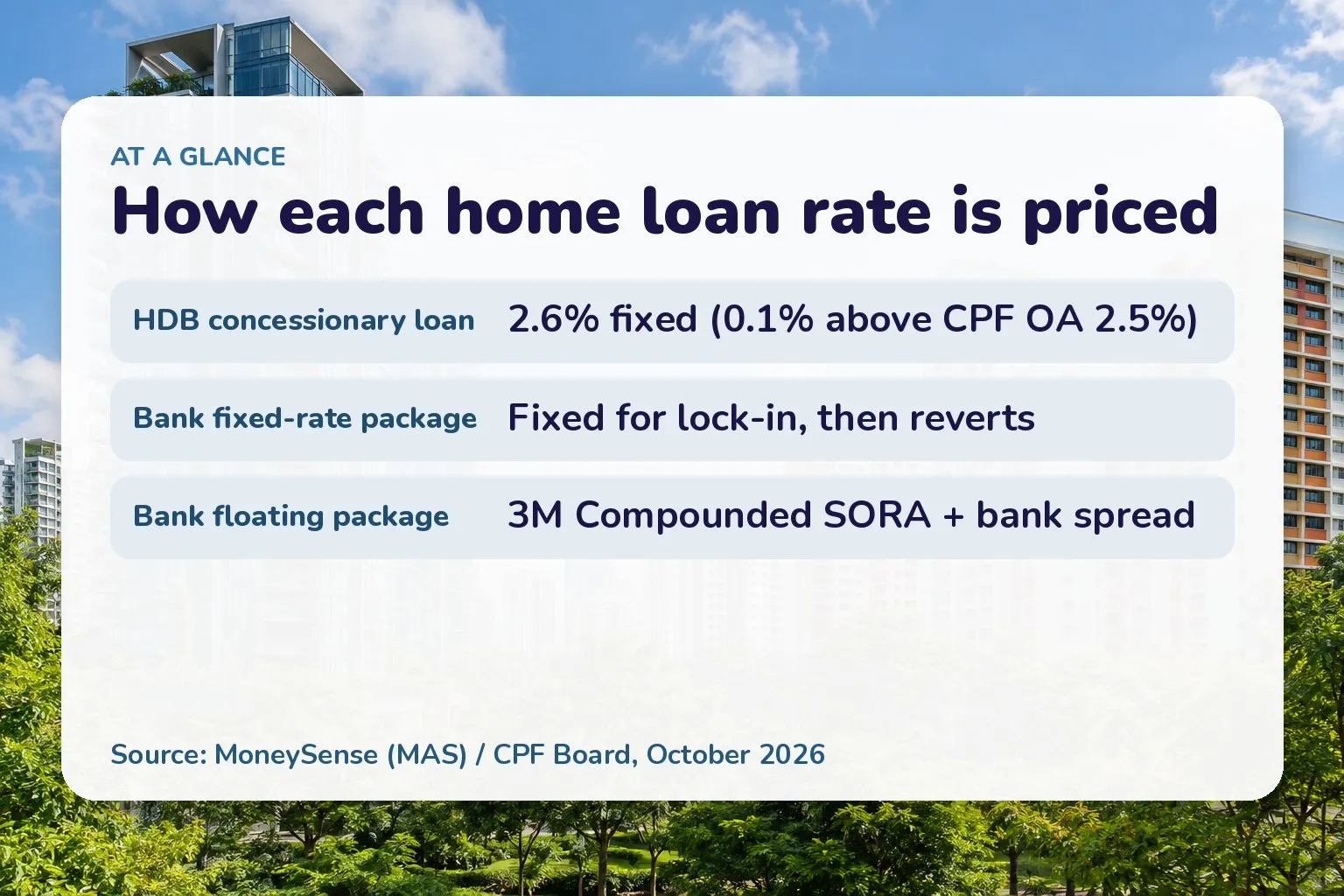
The HDB rate is fixed; bank fixed rates are temporary; floating rates track SORA plus a spread.
- HDB concessionary loan — 2.6% fixed. Pegged at 0.1% above the CPF Ordinary Account (OA) rate (2.5%), so it moves only when that rate changes — which is rare. HDB flats only, with eligibility conditions.
- Bank fixed-rate package. The bank fixes your rate for a lock-in period (commonly one to three years). When that ends, the loan reverts to a floating or board rate — so the “fixed” rate is temporary.
- Bank floating package. Priced as a benchmark plus a spread, almost always 3-month Compounded SORA + a margin the bank sets. Your rate resets as SORA moves.
Where SORA is now
SORA — the Singapore Overnight Rate Average — is the benchmark that replaced SIBOR and SOR for Singapore-dollar loans. Floating home loans reference the 3-month Compounded version, published by MAS.
As of 22 October 2026, 3-month Compounded SORA was 1.26%. MAS has noted it is “around 1.2%, below its 10-year average of 1.5%” — a reminder that today’s low benchmark can rise toward, or above, its long-run average over the life of a 25-year loan.
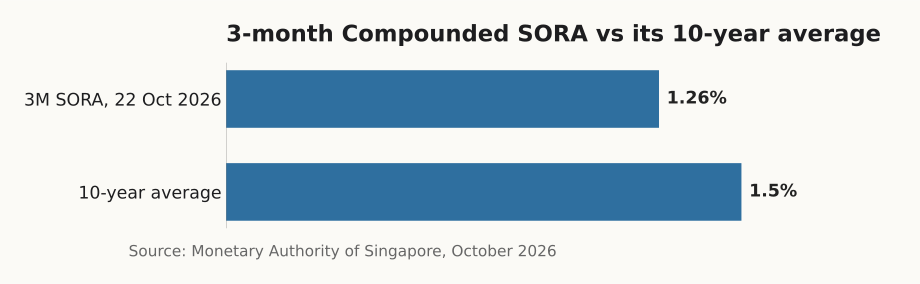
3-month Compounded SORA is the benchmark floating home loans are priced off — you still add the bank’s spread. — Source: Monetary Authority of Singapore, October 2026.
Fixed vs floating: what you are really trading
Neither is “better” — you are choosing certainty versus the chance of a lower rate.
- Fixed gives a known instalment for the lock-in, useful if you want budgeting certainty or expect rates to rise. You usually pay a small premium for that certainty, and you are exposed to the revert rate once the fixed period ends.
- Floating (SORA) can be cheaper when the benchmark is low, and SORA is transparent and published daily. But your instalment changes at each reset, so you carry the interest-rate risk.
What actually decides the cost
The rate is only part of the all-in price. When you compare packages, line up:
| What to compare | Why it matters |
|---|---|
| Spread / margin over SORA | The part the bank sets; the real competitive lever on floating loans |
| Lock-in period | How long you are tied in; leaving early can trigger a penalty |
| Revert rate | What a fixed package becomes after the lock-in ends |
| Early-repayment penalty | Often around 1.5% of the outstanding amount inside the lock-in |
| Legal / valuation subsidy | A rebate that offsets switching costs (and may be clawed back if you leave early) |
| Free conversion | Some packages allow one free repricing after lock-in |
| Effective Interest Rate (EIR) | Folds fees into one comparable number — compare this, not the headline |
How much you can borrow caps the choice
Your rate choice sits inside MAS’s borrowing limits. The loan is capped at 75% loan-to-value for a first home loan (so a 25% downpayment, at least 5% in cash for a bank loan), and your repayment must fit within TDSR (55% of gross monthly income) — plus MSR (30%) if you are buying an HDB flat or new executive condo. Banks also size the loan against a medium-term stress rate well above today’s SORA, so a low benchmark does not automatically mean a bigger loan.
See TDSR and MSR limits explained for the maths, and HDB loan vs bank loan for the full trade-off between the 2.6% HDB loan and a bank package.
So how should you compare?
- Want certainty? A fixed package or the HDB loan removes repricing surprises; accept you may not have the lowest rate.
- Comfortable monitoring rates? A SORA floating package can be cheaper now — just watch the spread and reset, and review before any lock-in ends.
- Always compare the EIR across at least two or three packages, check the revert rate and fees, and remember the benchmark can rise.
Rates and packages change constantly; compare current offers through a licensed comparison service or your bank’s fact sheet. We publish official benchmarks and rules, not product recommendations.
Related
- HDB loan vs bank loan: which is cheaper?
- TDSR and MSR limits explained
- When to refinance your home loan
General information, not financial advice. Benchmark and rates as of October 2026; check MAS, CPF and your bank for current figures.
Sources
- Domestic Interest Rates (SORA) — Monetary Authority of Singapore (as of 22 October 2026)
- Oral reply to Parliamentary Question on the impact of sustained increases in US Treasury yields — Monetary Authority of Singapore (as of October 2026)
- Government extends 4% interest rate floor on SMRA monies until 31 December 2027 — Central Provident Fund Board (as of 22 September 2026)
- How Home Loans Work — MoneySense (MAS) (as of October 2026)
- Switching to SORA: What You Need to Know — MoneySense (MAS) (as of October 2026)