When to Refinance Your Home Loan

Refinance once your lock-in period has ended and the interest you save over your remaining tenure clearly beats the switching cost. If you are still locked in, or the rate gap is small, ask your current bank to reprice instead — it avoids legal and valuation fees.
Refinancing can cut your monthly instalment, but only if the interest you save beats what it costs to switch. In Singapore that decision turns on four things: your lock-in period, any subsidy claw-back, the switching fees, and how long you will keep the loan. Get the timing right and the maths is easy; get it wrong and you pay to move for no gain.
Refinancing vs repricing
These are different moves, and the cheaper one is often the one people skip.
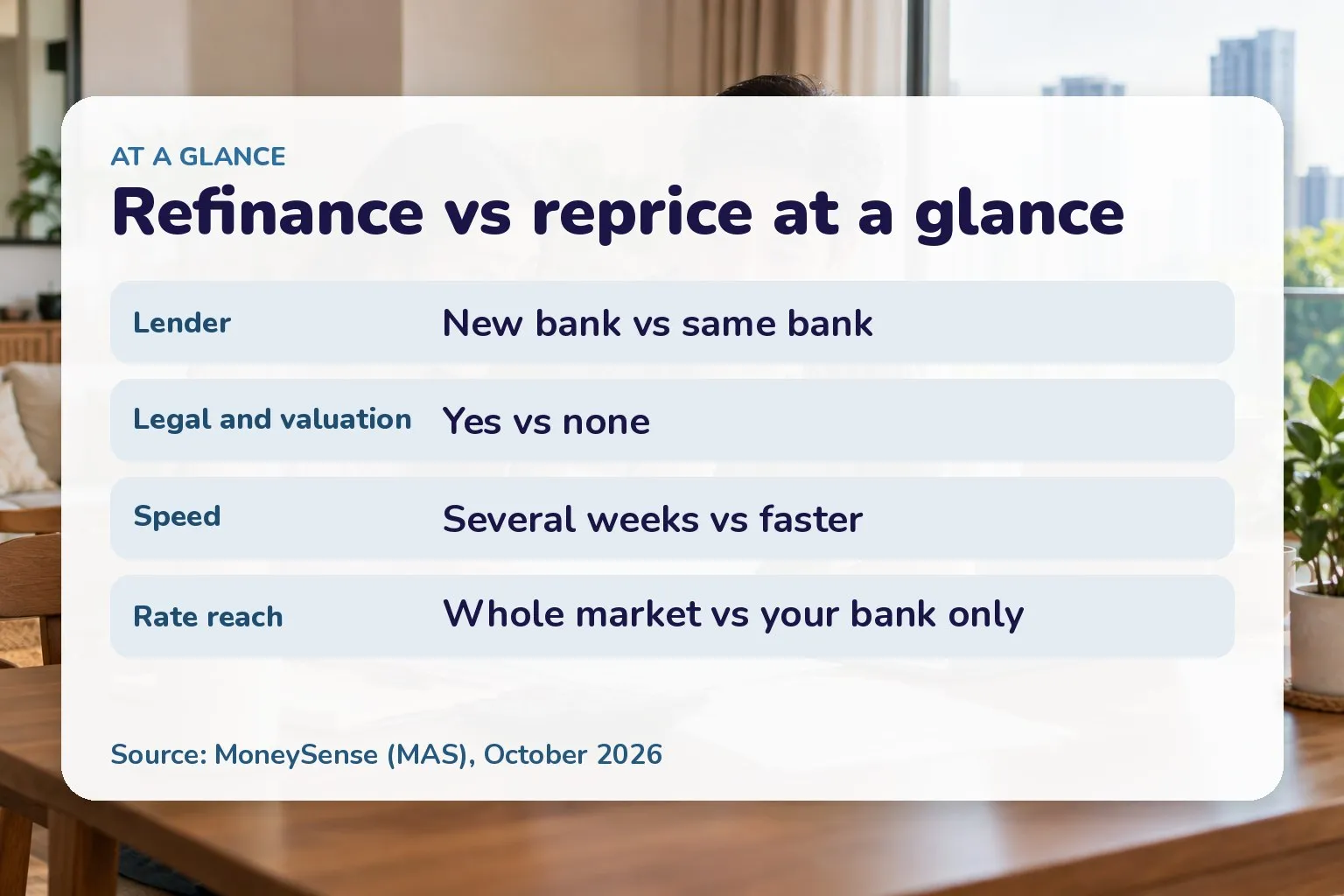
Repricing stays with your bank and skips legal work; refinancing opens the whole market at a cost.
- Refinancing means switching to a new bank that pays off your existing loan and issues a fresh mortgage — usually to reach a lower rate, but with legal and valuation work.
- Repricing (also called conversion) means taking a new package with your current bank. There is no legal or valuation work, so it is faster and cheaper, though the rate may be slightly less sharp.
When it is worth doing
Refinance (or reprice) when all of these line up:
- Your lock-in has ended. Redeeming inside the lock-in usually triggers an early-repayment penalty, commonly around 1.5% of the outstanding loan — on a S$500,000 balance that is about S$7,500, enough to erase most savings.
- The rate gap is real. A small difference rarely covers the switching cost over your remaining tenure.
- You will hold the loan past the claw-back window. If you may sell or move again soon, the subsidy claw-back can turn a win into a loss.
The costs that catch people out
The headline rate is the easy part. These line items decide whether a switch pays:
| Cost | What to expect | When it applies |
|---|---|---|
| Early-repayment penalty | Around 1.5% of the outstanding loan | Only inside your current lock-in period |
| Subsidy claw-back | Repay the legal/valuation subsidy or cash rebate you received | If you exit within the claw-back window (commonly 3 years) |
| Legal / conveyancing | Roughly S$1,800–2,500 | Refinancing to a new bank (often subsidised) |
| Valuation | A few hundred dollars | Refinancing to a new bank (often absorbed) |
| Repricing / conversion fee | Smaller admin fee | Repricing with your current bank |
Re-qualifying: usually easier than a new purchase
Refinancing is a new loan application, but the rules are lighter than for a purchase. Under MAS rules, owner-occupiers are generally exempt from the Total Debt Servicing Ratio (TDSR) when refinancing their property loan, so a tighter income position does not automatically block a switch. If you refinance an investment property, or do not meet the exemption conditions, TDSR can still apply — so check before you assume. See TDSR and MSR limits explained.
Timing and notice
- Start about three to four months before your lock-in ends. Banks accept a formal application a couple of months before completion, and refinancing to a new bank can take several weeks.
- Mind the notice. Banks must give you at least 30 days’ notice of a rate or terms revision, and your loan contract sets the notice you must give to redeem — check your facility letter so a late notice does not cost you an extra month of interest.
- Compare on the Effective Interest Rate (EIR). The property loan fact sheet shows the EIR, lock-in and penalty fees; compare that, not the advertised rate.
One-way streets to remember
When the rate gap is real, your lock-in is over and you will stay past the claw-back window, refinancing (or repricing) is one of the cleanest ways to cut your housing cost. When any of those is missing, waiting usually wins. Compare current packages through a licensed comparison service or your bank’s fact sheet; we publish the rules and benchmarks, not product recommendations.
Related
- HDB loan vs bank loan: which is cheaper?
- Comparing home loan rates in Singapore
- TDSR and MSR limits explained
General information, not financial advice. Rules and benchmarks as of October 2026; fees and penalties vary by bank — check your loan facility letter, MAS and your lender for current terms.
Sources
- How Home Loans Work — MoneySense (MAS) (as of October 2026)
- Switching to SORA: What You Need to Know — MoneySense (MAS) (as of October 2026)
- Information Paper on Residential Mortgage Pricing and Disclosure Practices — Monetary Authority of Singapore (as of October 2026)
- Calculating TDSR for Property Loans — Monetary Authority of Singapore (as of October 2026)
- Domestic Interest Rates (SORA) — Monetary Authority of Singapore (as of 22 October 2026)