CPF Accrued Interest on Housing Explained
CPF accrued interest is the interest your CPF savings would have earned had you not spent them on your flat. You refund the principal plus this interest when you sell, and it keeps compounding at 2.5% a year until then.
On this page10 sections · tap to jump
When you pay for a flat with CPF, the money is not gone — it is lent from your own retirement savings, and you owe it back with interest the day you sell. That interest is CPF accrued interest, and because it compounds for as long as you hold the flat, it is the figure most buyers underestimate. This guide explains what it is, how it grows, and exactly what you refund when you sell.
What CPF accrued interest is
Accrued interest is “the interest your CPF savings would have earned if they had remained in your account rather than being used for property purchase”. In other words, it is the growth your money gave up by going into bricks instead of staying in your CPF.
Refunding it matters because, as the CPF Board puts it, “refunding both the principal amount and accrued interest ensures your retirement savings are fully restored to what they would have been if they had remained in your CPF account. Without this refund, your retirement funds would be permanently reduced.” It is not a charge CPF keeps — every cent goes back into your own accounts.
The rate: 2.5% compounded yearly
Accrued interest is calculated “based on CPF’s prevailing interest rates and compounded annually”. The relevant rate is the Ordinary Account rate, which carries a legislated floor of 2.5% a year; for 1 October to 31 December 2026 the OA rate is 2.5%. The rate is reviewed quarterly and can rise above the floor, but it has sat at 2.5% for OA savings for many years.
Compounding is what gives accrued interest its bite: each year’s interest is added to the balance and itself earns interest the next year. A sum left untouched roughly doubles every 28 years at 2.5%, and the clock runs the whole time you own the flat. For context on the wider sums CPF funds, see using CPF to buy an HDB flat.
When it starts and stops
The calculation “runs from the date you first used your CPF savings for the property until the date the CPF refund is made”. So it begins the moment your OA is first tapped — the downpayment, usually — and only stops when you refund, normally at sale.
What you refund when you sell
On a sale you refund the CPF principal you withdrew (P) plus the accrued interest (I) — “P+I” in CPF’s shorthand. The sale proceeds are used first to pay off the outstanding housing loan, then to refund the CPF you used, before any cash reaches you — so a big P+I refund lands directly on your take-home cash.
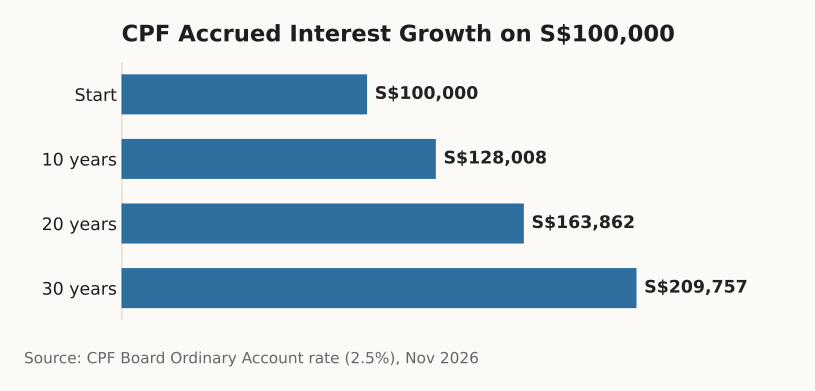
Illustrative: S$100,000 of OA used, grown at the 2.5% OA floor rate. Source: CPF Board OA rate, Nov 2026.
Two extra rules apply at age 55 and above. If you are 55 or over and “have pledged your property to set aside your retirement sum, you will also need to refund the pledged amount” on top of P+I. And any option money the buyer pays you in cash “is considered part of the selling price and must be refunded to your CPF account before the transaction can be completed”. See how the payout stacks up in the HDB selling process and fees.
Grants are refunded too
Housing grants are not a gift you keep on sale. The Terms and Conditions state you are “required to refund to your CPF account(s) the CPF principal amount withdrawn together with the accrued interest” — and that principal includes any CPF housing grant you used, because grants are credited to your CPF to buy the flat. Where you received “more than $30,000 in housing grants, part of it may be credited to your Special Account/Retirement Account and MediSave Account” rather than all to your OA, which can lock some of it away for retirement rather than freeing it for your next home.
If the sale cannot cover it
Where the refund goes
The refund returns to your own CPF, but where depends on your age. “If you are below 55, your housing refunds will be credited to your Ordinary Account (OA). If you are above 55, your housing refunds will be first used to top up your Retirement Account (RA) to meet your required retirement sum and the balance refunds will remain in your OA.” So for over-55s, part of the refund can be committed to retirement income rather than returned as spendable OA.
A worked example
How to keep accrued interest down
Answer: refund some of it early. The CPF Board encourages voluntary housing refunds — “to reduce the amount you need to refund when you sell your property, consider making voluntary housing refunds”, which also lets the money “enjoy the attractive interest rates of your CPF savings” again. The earlier you refund, “the more interest you will earn to boost your CPF savings for retirement”, and you may receive more cash proceeds at sale because you owe less. Using more cash and less CPF at the outset works the same way, by leaving less principal to accrue. If you are weighing CPF against renting, the buy versus rent calculator can frame the cash picture.
Frequently asked questions
Is accrued interest paid to CPF or to me? To you. Both the principal and the accrued interest go back into your own CPF accounts to restore your retirement savings; CPF does not keep any of it.
Does accrued interest stop when I finish paying my loan? No. It is based on the CPF you withdrew, not your loan, so it keeps compounding until you refund it — normally when you sell.
Can I check my current P+I without selling? Yes. The “What Happens If” section of your CPF Home ownership dashboard shows the refund you would owe if you sold today.
Do I ever lose money to accrued interest? Not to CPF — the refund returns to you. But because it is settled before your cash proceeds, a large P+I can leave you with little or no cash from the sale.
Related
- Using CPF to buy an HDB flat
- Selling your HDB flat: process and fees
- The real cost of buying an HDB flat
- How to price your resale flat
General information to help you plan, not financial or property advice. Confirm your exact figures with the CPF Board. We do not represent buyers or sellers.
Sources
- Why do I need to refund the accrued interest on CPF used for my property? — Central Provident Fund Board (as of November 2026)
- CPF refund when selling or transferring property — Central Provident Fund Board (as of November 2026)
- Terms and conditions for use of CPF under the CPF Housing Scheme — Central Provident Fund Board (as of November 2026)
- Earning CPF interest (Ordinary Account rate) — Central Provident Fund Board (as of November 2026)
- Do I have to refund the housing grant to my CPF account upon sale? — Central Provident Fund Board (as of November 2026)
- I have made a voluntary refund. Do I still need to refund when I sell? — Central Provident Fund Board (as of November 2026)