Using CPF to Buy an HDB Flat: Limits and Rules
You can use CPF Ordinary Account savings for an HDB flat's downpayment, purchase price, stamp duty and legal fees, but the option fee stays in cash and OA usage is capped by the valuation limit. You refund it with interest when you sell.
On this page9 sections · tap to jump
Your CPF Ordinary Account (OA) can pay for most of an HDB flat — the downpayment, the purchase price, stamp duty and legal fees — but not everything, and not without limits. How much you can draw depends on your loan type, the flat’s valuation and its remaining lease, and every dollar you use must be refunded with interest when you eventually sell. This guide sets out exactly what CPF can and cannot cover, and the rules that decide the amount.
What CPF can pay for
Your OA savings can be used to buy an HDB flat or to buy or build a private residential property in Singapore. Beyond the price itself, the CPF Board confirms OA savings can also go towards “downpayment and housing loan taken for the property purchase, stamp and legal fees … as well as Home Protection Scheme premiums (for HDB flats only)”.
What CPF cannot touch is just as important for budgeting: the option fee (and, for a resale flat, the option exercise fee), any portion of the price above the flat’s valuation, and — on a bank loan — a minimum slice of cash. Those gaps decide how much cash you need ready, so size your overall budget with the affordability calculator before you commit.
The downpayment: CPF versus cash
How the downpayment splits between CPF and cash depends on your loan.
- New HDB flat, HDB loan: your OA can fund the 25% downpayment (the HDB loan covers at most 75% of the price since 20 August 2024) and the rest of the price, leaving only the option fee in cash.
- Resale HDB flat, HDB loan: OA can fund the downpayment and price up to the usage limit below, with the option fee and option exercise fee in cash.
- HDB flat or private property, bank loan: a minimum 5% of the price comes from cash, plus the option monies, before OA savings apply.
The live guide to the real cost of buying an HDB flat breaks that cash-versus-CPF split down line by line.
How much CPF you can use
There is a ceiling on OA usage so that housing does not swallow your retirement savings. The cap turns on remaining lease, property type and loan type.
Remaining lease. If the flat’s remaining lease “can last the youngest owner until age 95, the amount of CPF savings you can use is capped at the lower of the purchase price and the valuation price at the time of purchase” — this cap is the Valuation Limit (VL). If the lease cannot cover the youngest buyer to 95, your OA usage is pro-rated, and once that pro-rated limit is reached “you will not be able to use further OA savings for the property, regardless of whether you have set aside your Basic Retirement Sum”.
Property and loan type then set what happens at the VL:
| Purchase | OA you can use |
|---|---|
| New HDB flat from HDB, HDB loan | Full purchase price, including the loan |
| Resale HDB flat, HDB loan | Up to the VL; beyond it, more OA for the remaining loan only if you have set aside your BRS |
| HDB flat or private, bank loan | Up to the VL; beyond it, up to 120% of the VL (the Withdrawal Limit) only if you have set aside your BRS |
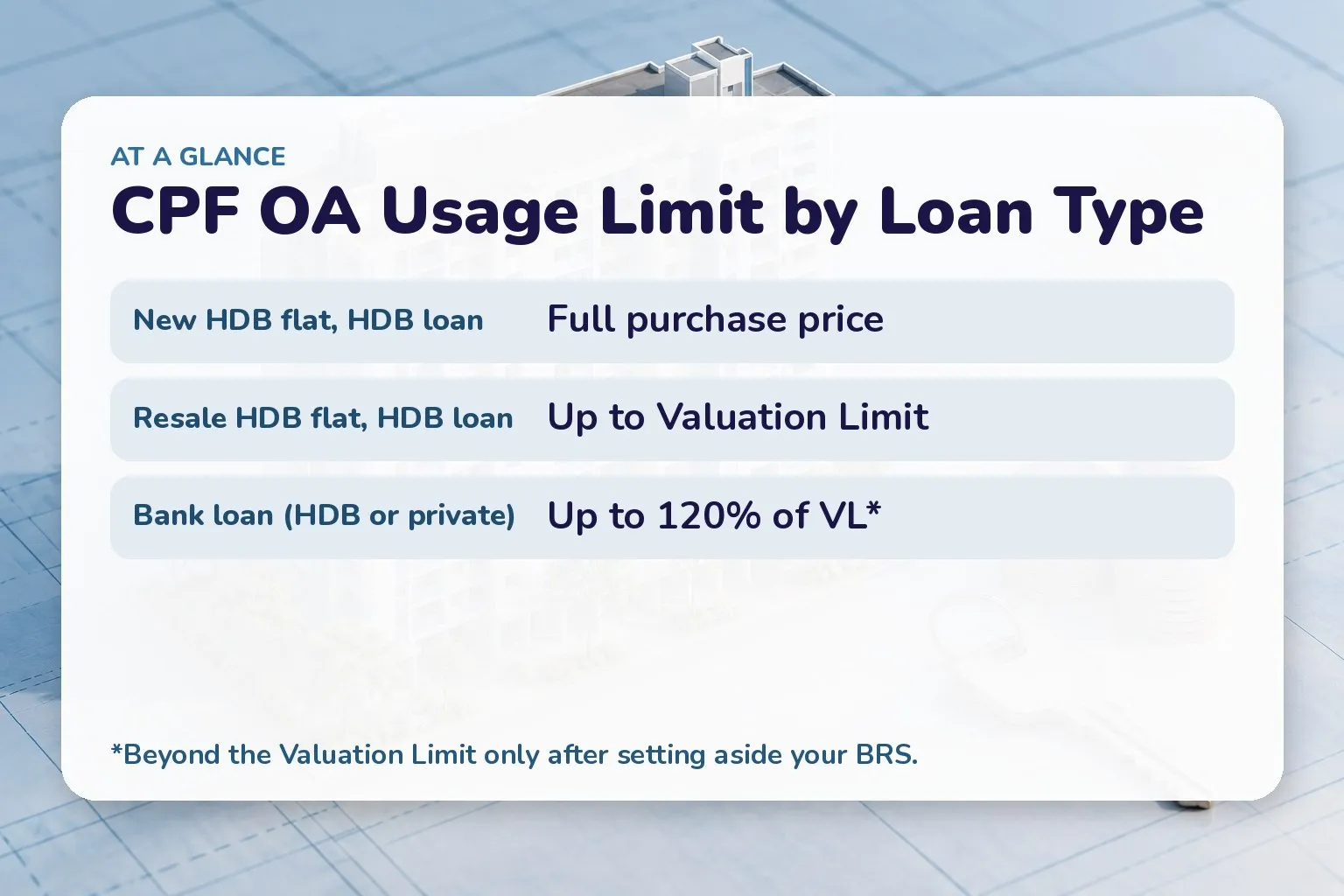
How far your CPF OA stretches depends on loan type. Source: CPF Board, Nov 2026.
CPF savings used for stamp duty, legal fees and upgrading costs are not counted in that housing limit — they sit outside it. For your own exact figure, the CPF Housing Usage Calculator computes the total OA you and any co-owner may use once you enter the flat’s valuation, purchase date and owners’ dates of birth.
Stamp duty, legal fees and HPS
Stamp duty (Buyer’s Stamp Duty, and any Additional Buyer’s Stamp Duty) can be paid from CPF, as can conveyancing legal fees; estimate the duty with the Buyer’s Stamp Duty and ABSD calculator. Because these are outside the housing limit, using CPF for them does not eat into the VL.
Buyers aged 55 and above, and second properties
Two situations change the sums. For a second or subsequent property, you can use OA savings only “after setting aside the BRS or FRS” — the Basic Retirement Sum if you already own a property that can last you to 95, otherwise the Full Retirement Sum — and then only up to the housing limit. For members aged 55 and above, the BRS is half of the Full Retirement Sum.
There is one concession for downsizers: if you are 55 or above and buying “a 3-room or smaller HDB flat, you can also use the excess savings in your Retirement Account (RA)” once you have set aside the prevailing BRS.
You must refund it later
CPF used for housing is not free money. When you sell, “you will need to refund the amount that you have used plus the interest accrued on this amount” — the principal plus accrued interest, back into your CPF to rebuild your retirement savings. That OA pays a floor of 2.5% a year (the rate for 1 October to 31 December 2026 is 2.5%), and the accrued interest you owe is based on that. Because it compounds for as long as you hold the flat, the refund can be far larger than the sum you drew — understand it fully in how CPF accrued interest on housing works.
Should you use cash or CPF?
Answer: there is no single right split; it is a choice between cash flow now and retirement savings later. Using CPF maximises the cash you keep for renovation, furniture and emergencies, which is why many first-timers lean on it heavily. But the accrued-interest refund means CPF-funded buyers often walk away with less cash when they sell than they expected. If you can comfortably service the loan in cash, doing so leaves your OA to compound untouched. Weigh your loan options first in HDB loan versus bank loan.
A worked example
Frequently asked questions
Can I pay the whole flat price with CPF? Only for a new HDB flat bought directly from HDB on an HDB loan, where OA can cover the full price including the loan. A resale flat is capped at the Valuation Limit, and a bank loan needs a minimum 5% cash downpayment first.
Can CPF pay my stamp duty and legal fees? Yes. Buyer’s Stamp Duty and conveyancing legal fees can be paid from CPF, and they are not counted towards your CPF housing usage limit.
Do I lose my CPF if I use it for a flat? No — but you must refund the principal plus accrued interest when you sell, so treat it as borrowing from your future self rather than spending.
What if my flat has a short remaining lease? Your CPF usage is pro-rated and hard-capped once the lease cannot cover the youngest buyer to age 95, regardless of your retirement savings. Use the CPF Housing Usage Calculator for the exact amount.
Related
- The real cost of buying an HDB flat
- CPF housing grants: eligibility and amounts
- How CPF accrued interest on housing works
- HDB loan vs bank loan
General information to help you plan, not financial or property advice. Confirm your exact figures with the CPF Board. We do not represent buyers or sellers.
Sources
- Using your CPF to buy a home (CPF Housing Scheme) — Central Provident Fund Board (as of November 2026)
- How much CPF savings you can use for your home purchase — Central Provident Fund Board (as of November 2026)
- Can I use my CPF savings for the down payment of my property? — Central Provident Fund Board (as of November 2026)
- How much CPF savings can I use for my property purchase? — Central Provident Fund Board (as of November 2026)
- Terms and conditions for use of CPF under the CPF Housing Scheme — Central Provident Fund Board (as of November 2026)
- Protecting against losing your home (Home Protection Scheme) — Central Provident Fund Board (as of November 2026)
- Earning CPF interest (Ordinary Account rate) — Central Provident Fund Board (as of November 2026)