HDB Income Ceiling: 2026 Limits Explained

The HDB income ceiling caps your average gross monthly household income to buy a subsidised flat, take an HDB loan or claim a CPF grant. From 24 August 2026 it is S$16,000 for families and S$8,000 for singles; a Standard resale flat bought without a grant has no ceiling.
On this page7 sections · tap to jump
The HDB income ceiling decides whether you can buy a subsidised flat, borrow from HDB, or receive a housing grant. It is not one universal number: it changes with the flat type, the route you take, and your household makeup. This guide sets out the figures that apply from 24 August 2026, shows where the ceiling genuinely does not apply, and explains exactly how HDB measures the income it compares against the limit — the part most buyers get wrong.
What the HDB income ceiling actually caps
The income ceiling is the maximum average gross monthly household income — the total of everyone listed in your HDB Flat Eligibility (HFE) letter application — that still lets you access subsidised housing. It is tested when you apply for the HFE letter, before you commit to a flat.
The ceilings were last raised in 2019 and are reviewed periodically as incomes grow. On 24 August 2026 they moved again: the family ceiling went from S$14,000 to S$16,000, and the ceiling for singles aged 35 and above went from S$7,000 to S$8,000. The revised figures apply to anyone who applies for an HFE letter on or after that date, so the application date — not when you start flat-hunting — is what fixes which ceiling you face.
The 2026 limits by flat type and route
There is no single ceiling — it depends on the flat and how you pay for it. The table below pulls together the figures that apply from 24 August 2026.
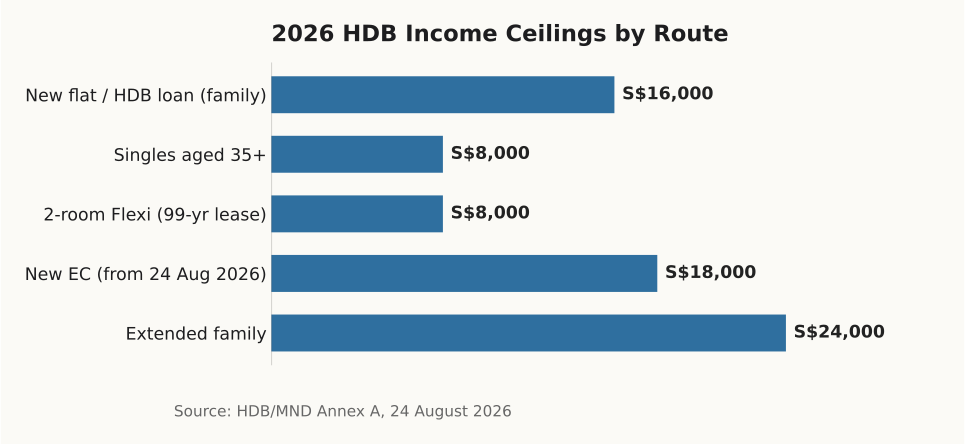
Monthly household income ceilings by route, effective 24 August 2026.
| Flat / route | Families | Singles (35+) |
|---|---|---|
| New flat from HDB (4- and 5-room, 3Gen) | S$16,000 | — |
| 2-room Flexi (99-year lease) | S$8,000 | S$8,000 |
| Resale flat with a CPF Housing Grant | S$16,000 | S$8,000 (own) / S$16,000 (with family or other singles) |
| HDB housing loan | S$16,000 | S$8,000 |
| Resale Plus flat | S$16,000 | S$16,000 |
| Resale 2-room Prime flat | S$16,000 (family) | S$8,000 |
| Standard or unclassified resale, own funds, no grant | No ceiling | No ceiling |
| New EC (tender closed on/after 24 Aug 2026) | S$18,000 | S$18,000 (joint singles) |
Two details catch people out. First, a 3-room new flat can carry either an S$8,000 or S$16,000 ceiling depending on the project — HDB states the figure in each launch’s press release, so check the specific exercise. Second, extended or multi-generation families get a higher ceiling of S$24,000 (1.5 times the family figure), but each family nucleus inside that household must still stay within S$16,000.
When the ceiling applies and when it does not
The ceiling applies at the point you reach for a subsidy — a new flat, an HDB loan, or a CPF housing grant — and on Plus and Prime resale flats. It does not apply to an ordinary open-market resale purchase paid with your own funds and a bank loan.
- Standard or unclassified resale, own funds, no grant and no HDB loan: no purchase income ceiling at all.
- CPF Housing Grant on a resale flat: S$16,000 for families; for singles, S$8,000 buying on your own or S$16,000 buying with family or other singles.
- Enhanced CPF Housing Grant (EHG): a separate and lower ceiling of S$9,000 for families, on top of the CPF Housing Grant — the EHG targets lower-income first-timers, so clearing S$16,000 does not mean you clear the EHG.
- Proximity Housing Grant (PHG): no income ceiling — it is the one grant that is excluded from the income test.
- HDB housing loan: S$16,000 for families, S$8,000 for singles, whether or not you take a grant.
This is also why the ceiling matters even to buyers who never touch a new flat. If you need the HDB concessionary loan rather than a bank loan, the S$16,000 / S$8,000 limit follows the loan — see how the two compare in HDB loan vs bank loan.
How HDB works out your household income
HDB does not look at your latest payslip. It takes your average gross monthly income over a 12-month period that ends two months before the month of your HFE application, then adds every applicant and occupier together. Apply in May, for example, and the window runs from the previous April to the March just gone.
The average is taken over the months actually worked: months on no-pay leave are treated as unemployment and dropped from the count, which can lift your assessed average rather than lower it. What goes into the figure is just as important:
- Counted: basic salary and wages, overtime pay, and fixed or variable allowances (transport, shift, uniform, food). Your own CPF contribution stays in the figure because it uses gross pay.
- Not counted: bonuses and the Annual Wage Supplement, the employer’s CPF contribution, and income that is not from employment or a trade (such as rental or dividends).
You must also be working at the point of the HFE application to be considered for the Enhanced CPF Housing Grant and an HDB housing loan.
Executive condominiums: a separate, higher ceiling
A new EC has its own, higher ceiling: S$18,000 for new units in projects whose land sale tender closed on or after 24 August 2026. Projects whose tenders were awarded before that date keep the S$16,000 ceiling, and so do balance units in existing ECs — so the ceiling turns on the project’s tender date, not the year you buy.
A resale EC bought on the open market is different again: once it is being sold second-hand, it is private property and carries no monthly household income ceiling. If you are weighing an EC against a private condo, the eligibility trade-offs are set out in executive condo vs condo.
Over the ceiling? Your options
If your assessed income is above the limit for the route you want, the subsidised channel closes but ownership does not. A household over S$16,000 can still buy a Standard or unclassified resale flat on the open market (no purchase ceiling) with a bank loan, or buy a private property or a resale EC. What you lose is the new-flat ballot, the CPF housing grants, and the HDB concessionary loan.
A few practical moves before you conclude you are over:
- Check the assessment window, not today’s pay. If a recent raise lifted you over, applying earlier — while the lower pay still sits inside the 12-month window — can keep you under; a looming raise is a reason to apply sooner.
- Confirm the flat type. The S$8,000 lines (2-room Flexi 99-year lease, some 3-room projects) are far lower than the S$16,000 family ceiling, so the “right” flat can matter as much as the right income.
- Remember singles buying together. A single buying a resale flat with other singles or with family is assessed under the S$16,000 ceiling, not the S$8,000 solo limit — see singles buying an HDB flat.
Frequently asked questions
Is the income ceiling based on gross or take-home pay? Gross. HDB uses your pay before deductions and keeps your own CPF contribution in the figure, but excludes the employer’s CPF share and bonuses.
Does a bonus push me over the ceiling? No. Bonuses and the Annual Wage Supplement are excluded from the assessment. Regular allowances and overtime, however, are counted.
I earn more than S$16,000 — can I still buy an HDB flat? Yes, on the open market. A Standard or unclassified resale flat bought with your own funds and no grant has no income ceiling. You would not qualify for a new flat, a CPF housing grant or the HDB loan.
What income ceiling applies if I buy a resale flat with a grant? S$16,000 for families; for singles, S$8,000 buying on your own or S$16,000 buying with family or other singles. The Proximity Housing Grant is the exception, with no income ceiling.
When did the ceiling last change? On 24 August 2026 it rose to S$16,000 for families and S$8,000 for singles, the first increase since 2019. The new EC ceiling became S$18,000 for qualifying projects.
General information, not financial or property advice. We do not represent buyers or sellers. Income ceilings and eligibility rules change — check HDB for the current figures when you apply.
Sources
- Increase in Income Ceilings and Greater Support for Families with Children (MND & HDB) — Ministry of National Development (as of 23 August 2026)
- Annex A: Revised Income Ceilings for Citizen Families and Singles — Housing & Development Board (as of 22 August 2026)
- Couples and Families (flat, grant and loan eligibility) — Housing & Development Board (as of November 2026)
- Singles (flat, grant and loan eligibility) — Housing & Development Board (as of November 2026)
- Income Guidelines and Documents for HFE Letter Application — Housing & Development Board (as of November 2026)
- Housing Loan from HDB — Housing & Development Board (as of November 2026)
- Eligibility for Buying an Executive Condominium — Housing & Development Board (as of November 2026)