Property Cooling Measures: A Timeline
Cooling measures are tax and loan curbs on property demand. Those in force in 2026 include ABSD (up to 60% for foreigners), a four-year Seller's Stamp Duty, a 55% TDSR cap and a 75% HDB loan limit.
Singapore has steered its housing market with “cooling measures” for more than fifteen years — a running series of tax and loan curbs meant to keep prices in line with incomes and discourage short-term speculation. This page walks through them in order, then shows which rules actually apply to a buyer or seller in 2026. Every figure here is dated, because these rules change often and the version in force depends on when you transact.
What cooling measures are
Cooling measures are not one law but a toolkit, adjusted round by round by the Ministry of Finance, the Ministry of National Development (MND), the Monetary Authority of Singapore (MAS), the Inland Revenue Authority (IRAS) and HDB. Four levers do most of the work:
- Additional Buyer’s Stamp Duty (ABSD) — an extra tax on top of Buyer’s Stamp Duty, scaled to your residency and how many homes you already own.
- Seller’s Stamp Duty (SSD) — a tax on private homes sold within a few years of purchase.
- Total Debt Servicing Ratio (TDSR) and the Mortgage Servicing Ratio (MSR) — caps on how much of your income can go to debt.
- Loan-to-Value (LTV) limits — caps on how much you can borrow against a property.
MAS publishes an official running history of these in its “Macroprudential Policies in Singapore” record, going back to 1996.
The timeline, round by round
February 2010. The modern cycle began here. A Seller’s Stamp Duty was introduced on residential property sold within one year of purchase, and the bank-loan LTV limit was lowered to 80%.
January 2011. SSD was sharpened into a real deterrent: the holding period was extended from three to four years and the rates raised to 16%, 12%, 8% and 4% for a sale in the first, second, third and fourth year.
December 2011. ABSD was introduced for the first time — initially modest (10% for foreigners and entities, with small rates for citizens’ and PRs’ additional purchases).
January 2013. ABSD was raised across the board, and the MSR was capped at 30% of income for HDB flats bought with a bank loan.
June 2013. The TDSR framework arrived, capping total monthly debt repayments at 60% of gross income across all property loans — the single most structural change of the decade.
March 2017. A small easing: the SSD holding period was trimmed back to three years and the rates cut by four points per tier (to 12/8/4/0%). Cooling measures can loosen, not only tighten.
July 2018. ABSD was raised again and LTV limits tightened after a sharp price run-up.
16 December 2021. A broad package landed near midnight. ABSD rose for second and subsequent purchases; the TDSR threshold was tightened from 60% to 55%; and the HDB loan LTV limit fell from 90% to 85%.
30 September 2022. With interest rates climbing, the Government tightened loan limits again. MAS raised the medium-term interest rate floor used to compute TDSR and MSR by 0.5 point; HDB introduced a 3% interest rate floor to compute the eligible loan amount; the HDB loan LTV limit dropped from 85% to 80%; and a 15-month wait-out period was imposed on private-property owners (and ex-owners) buying a non-subsidised HDB resale flat.
27 April 2023. The headline round for the private market: ABSD was raised steeply, most notably doubling the foreigner rate from 30% to 60% and lifting the entity rate to 65%.
20 August 2024. A two-sided HDB package — the HDB loan LTV limit was lowered again, from 80% to 75%, while the Enhanced CPF Housing Grant (EHG) was raised to up to $120,000 for first-timer families (and up to $60,000 for singles).
4 July 2025. The latest supply-side curb on quick private resales: SSD returned to a four-year holding period, with rates raised four points per tier back to 16/12/8/4%.
28 July 2026. The first easing in this list: MND removed the 15-month wait-out period with immediate effect for private-property owners and ex-owners who buy a non-subsidised HDB resale flat without an HDB housing loan.
What applies today
Here is the snapshot a 2026 buyer or seller actually faces:
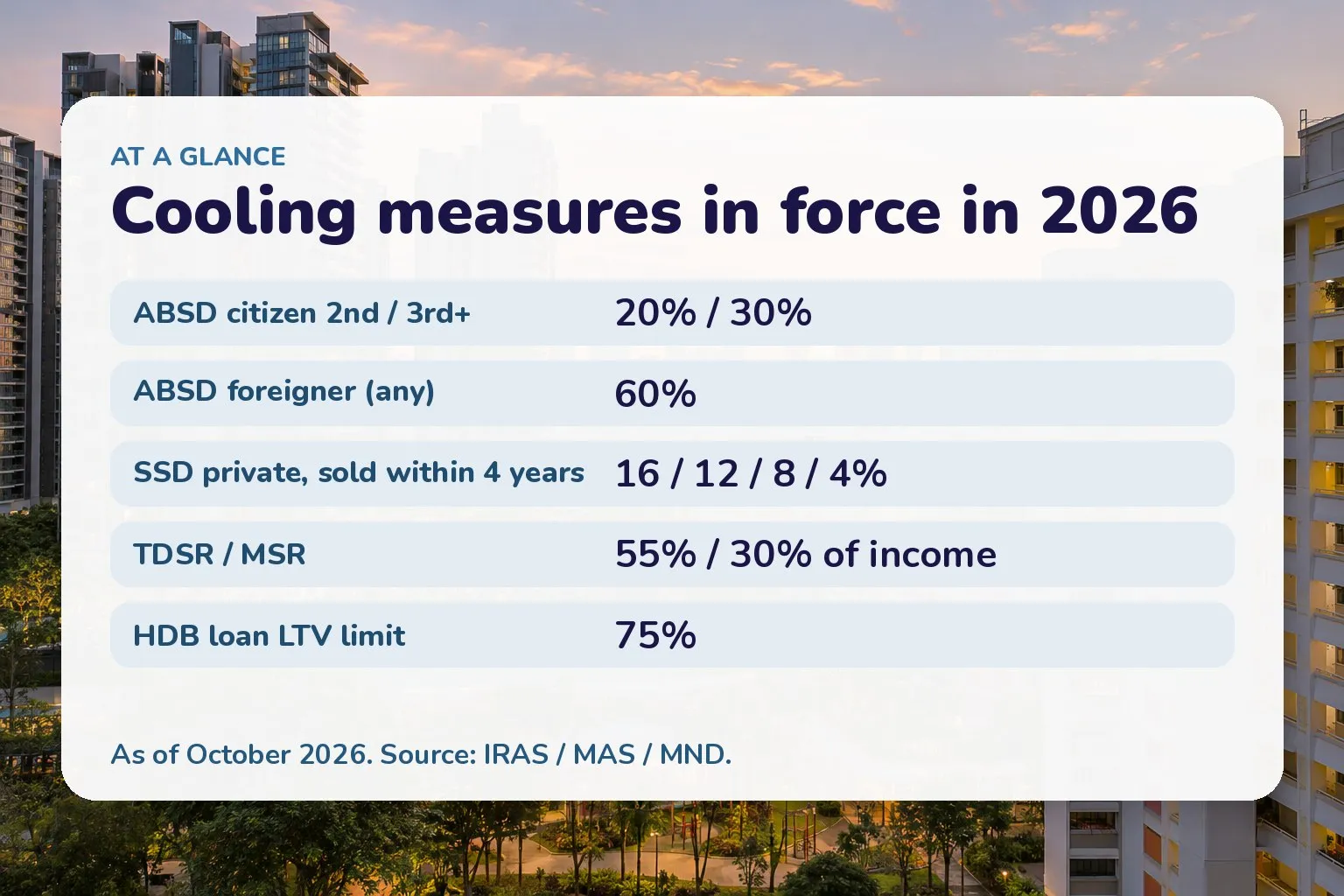
The curbs a 2026 buyer or seller actually faces. Source: IRAS, MAS, MND.
| Lever | In force (2026) | Since |
|---|---|---|
| ABSD — citizen 1st home | 0% | 27 Apr 2023 |
| ABSD — citizen 2nd / 3rd+ | 20% / 30% | 27 Apr 2023 |
| ABSD — PR 1st / 2nd / 3rd+ | 5% / 30% / 35% | 27 Apr 2023 |
| ABSD — foreigner (any) | 60% | 27 Apr 2023 |
| ABSD — entity / trustee | 65% | 27 Apr 2023 |
| Buyer’s Stamp Duty (residential) | up to 6% marginal | 15 Feb 2023 |
| SSD (private, sold within 4 years) | 16 / 12 / 8 / 4% | 4 Jul 2025 |
| TDSR | 55% of gross income | 16 Dec 2021 |
| MSR (HDB flats) | 30% of gross income | since 2013 |
| HDB loan LTV limit | 75% | 20 Aug 2024 |
| 15-month wait-out (private owner → resale HDB, no HDB loan) | removed | 28 Jul 2026 |
Work out your own upfront duty with the Buyer’s Stamp Duty and ABSD calculator, and see how the income caps limit your loan in TDSR and MSR explained.
ABSD today
ABSD is charged on the purchase price or market value, whichever is higher, and is set by your buyer profile (citizen, PR, foreigner or entity) and your count of residential properties. A Singapore citizen buying a first home pays none. Where buyers of different profiles purchase jointly, the highest applicable rate applies to the whole property. For foreigners, the 2023 jump to 60% was the largest single ABSD change in the series. These figures feed directly into the upfront cash in our total cost of buying an HDB flat guide.
Seller’s Stamp Duty today
Since 4 July 2025, a private residential property sold within four years of purchase attracts SSD of 16% (first year), 12%, 8% and 4%, falling to zero only after the fourth year. IRAS counts the holding period from the date the Option to Purchase was accepted, and there is no transition period.
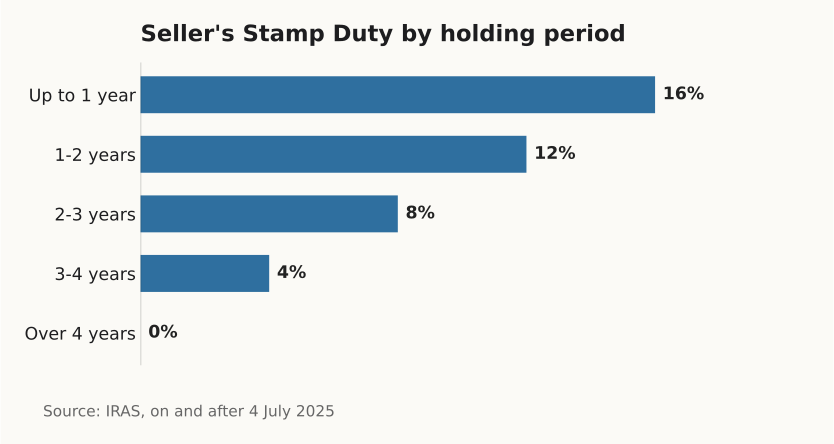
SSD on private residential property sold within four years. Source: IRAS, from 4 July 2025.
HDB flats vs private: what hits which
Not every measure touches every buyer. Broadly:
- HDB flat buyers feel the HDB loan LTV limit (75%), the MSR (30%), the HDB loan interest-rate floor (3% for computing the loan amount). Private-home owners buying a resale flat without an HDB loan no longer face the 15-month wait-out (removed 28 July 2026). ABSD rarely applies, because most are first-time citizen buyers.
- Private property buyers feel ABSD most of all, plus BSD, TDSR (55%) and SSD on a quick resale.
The 15-month wait-out, introduced on 30 September 2022, barred a private-home owner (or recent ex-owner) from buying a non-subsidised resale HDB flat until 15 months after disposing of the private property. MND removed it with immediate effect on 28 July 2026 for buyers who purchase without an HDB housing loan, so those buyers can now buy a resale flat straight away; check HDB’s eligibility page for your case if you need an HDB loan.
The 2026 demand-side change
Cooling the market is only half the picture; the Government also tunes who can access subsidised housing. From 24 August 2026, the monthly household income ceiling to buy a new subsidised HDB flat, to take an HDB housing loan, or to buy a resale flat with a CPF Housing Grant was raised from $14,000 to $16,000 for families, and from $7,000 to $8,000 for singles aged 35 and above. The new-EC-from-developer ceiling rose to $18,000. This widens eligibility rather than restricting it — a reminder that “housing policy” and “cooling measures” are not the same thing.
Are they permanent?
No. The Government has repeatedly described these as measures that “will be reviewed in future depending on market conditions” — and the March 2017 easing and the 2024–2026 support changes prove they can loosen as well as tighten. Treat any figure as a snapshot: confirm the rate on your transaction date with IRAS, MAS, MND or HDB before you commit.
Before you commit
The through-line of fifteen years of measures is simple: the rule that counts is the one in force on your transaction date, and that date is usually when the Option to Purchase is granted. Next, see how the loan caps shape your budget in TDSR and MSR explained, and if you are weighing new versus existing, compare BTO vs resale.
FAQ
Do cooling measures apply to commercial or industrial property? ABSD and SSD for residential property do not apply to most commercial units, though an SSD on industrial property has existed since 2013. This guide covers residential rules only.
I bought before a rule changed — am I affected? Generally no. Each round keys to the transaction date (usually the OTP date). A later rule does not retroactively tax a purchase made under the old rules; refinancing an existing loan is also usually protected from a newly tightened TDSR.
Where do I check the current rate? IRAS for ABSD, BSD and SSD; MAS for TDSR and LTV; HDB and MND for flat-specific limits and income ceilings. We date every figure on this page so you can confirm it against the source.
General information, not property, tax or financial advice. Confirm current rates with IRAS, MAS, MND and HDB. We do not represent buyers or sellers.
Sources
- Removal of the 15-month Wait-out Period for Private Residential Property Owners Purchasing Non-Subsidised HDB Resale Flats — Ministry of National Development (as of October 2026)
- History of Macroprudential Policies in Singapore — Monetary Authority of Singapore (as of October 2026)
- Additional Buyer's Stamp Duty (ABSD) — Inland Revenue Authority of Singapore (as of October 2026)
- Seller's Stamp Duty (SSD) for Residential Property — Inland Revenue Authority of Singapore (as of October 2026)
- Measures to Cool the Property Market (16 December 2021) — Ministry of National Development (as of October 2026)
- Measures to Promote Sustainable Conditions in the Property Market (30 September 2022) — Monetary Authority of Singapore / MND / HDB (as of October 2026)
- Measures to Cool the HDB Resale Market (20 August 2024) — Ministry of National Development (as of October 2026)
- Stamp Duty rates (BSD, ABSD history) — Inland Revenue Authority of Singapore (as of October 2026)
- Measures to Maintain a Stable and Sustainable Property Market (13 January 2011) — Monetary Authority of Singapore (as of October 2026)
- Increase in Income Ceilings and Greater Support for Families with Children (24 August 2026) — Ministry of National Development (as of October 2026)