Freehold vs Leasehold Property in Singapore
Freehold means you own the land with no expiry; leasehold — usually 99 years — returns the land to the State when it ends. Freehold costs more and resists lease decay; leasehold is cheaper to enter and makes up almost all new private launches.
On this page10 sections · tap to jump
- 01Quick verdict
- 02What the two tenures mean
- 03999-year leasehold: almost freehold
- 04Why leasehold dominates new launches
- 05How value differs: lease decay and the SLA table
- 06Financing: CPF and loans by remaining lease
- 07The price gap: what you pay for perpetuity
- 08Can you extend a leasehold?
- 09Which tenure should you choose?
- 10Frequently asked questions
Scroll any Singapore condo listing and one word decides a surprising amount: tenure. Freehold or 99-year leasehold changes the price you pay, how much CPF and loan you can use, how the home holds value, and how easy it is to sell later. This guide explains what each tenure legally means, how value and financing differ as a lease runs down, how big the freehold premium really is, and which tenure suits which buyer — grounded in the official SLA, CPF, MAS and URA positions.
Quick verdict
There is no single winner — the right tenure depends on your horizon and budget:
- Buying to hold for the long term, or to pass on (legacy): freehold wins. It never decays and compounds as a scarce, land-backed asset.
- First home, tighter budget, or buying mainly for location and rental yield: a well-located 99-year leasehold wins. You pay less to get in, and early-life appreciation is often location-led, not tenure-led.
- Want freehold-like permanence without the top premium: a 999-year leasehold is the runner-up to freehold — valuers and banks treat it as effectively perpetual.
The rest of this guide shows the numbers behind each call.
What the two tenures mean
In Singapore, all land is held by the State. You never own land absolutely; you hold an estate — a tenure — in it. There are two broad kinds for homes:
- Freehold (legally a fee simple or an estate in perpetuity): “a perpetual, non-expiring right of ownership to the land,” in the Singapore Land Authority’s words. There is no expiry date.
- Leasehold: “the temporary right of ownership” for a fixed term — residential leases usually run 99 years. At the end of the term, “the ownership of the land returns to the State.”
That last line is the whole story of leasehold: you buy the right to use the land for a set number of years, and when they run out, it reverts to the State.
999-year leasehold: almost freehold
A handful of older projects sit on 999-year leases. Legally these are still leasehold, but with a reversion nearly a thousand years away, the practical difference from freehold is negligible — a 999-year term stretches across roughly twelve generations. Banks and valuers treat a 999-year lease as effectively freehold, which is why you will often see it marketed alongside true freehold. The gap only matters to a purist: a freehold fee simple is the closest thing to absolute ownership Singapore grants.
Why leasehold dominates new launches
If freehold is better, why is almost every new condo 99-year leasehold? Because the State stopped issuing fresh freehold land decades ago. The practice of granting 99-year leases instead of freehold traces back to the Crown Land Rules of 1947, which proclaimed that 99-year leases “would be issued in all instances, instead of freehold title.” Today’s Government Land Sales — the pipeline that feeds most new private projects — are sold on 99-year leases.
The consequence for buyers is scarcity: the stock of freehold homes is fixed and slowly shrinking as a share of the market, concentrated in older districts. That scarcity is a big part of why freehold commands a premium.
How value differs: lease decay and the SLA table
A leasehold home loses value as its lease shortens — lease decay — but not at a steady rate. The Singapore Land Authority maintains a Leasehold Table (known in the trade as “Bala’s Table”) that sets the value of land with a given remaining lease as a percentage of its freehold value. Published online since 2000, it is used to price land premiums. The headline relativities:
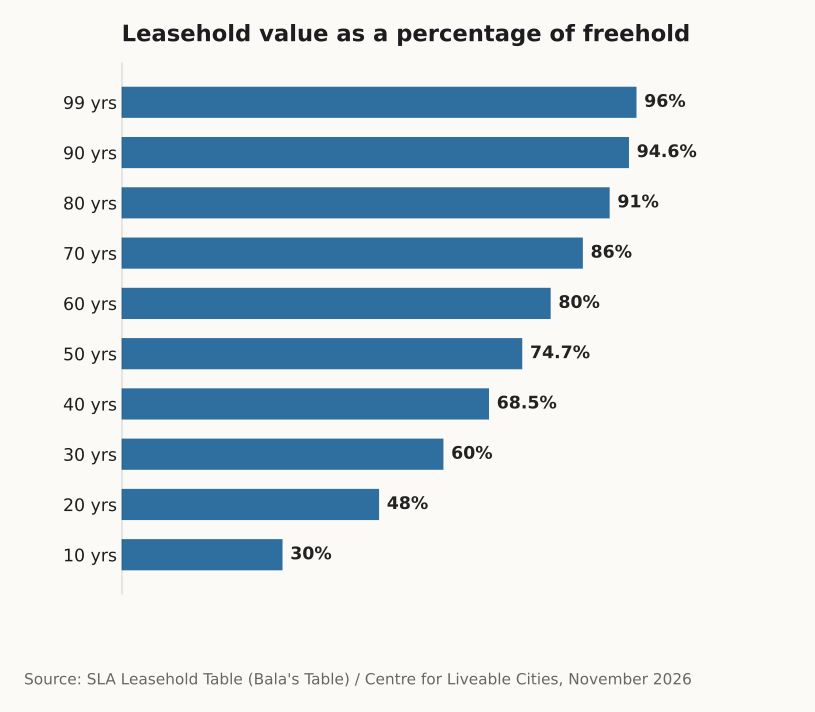
Land value by remaining lease, as a share of freehold value. The decline steepens as the lease shortens.
| Remaining lease | Value as % of freehold (SLA table) |
|---|---|
| 99 years | 96% |
| 90 years | 94.6% |
| 80 years | 91% |
| 70 years | 86% |
| 60 years | 80% |
| 50 years | 74.7% |
| 40 years | 68.5% |
| 30 years | 60% |
| 20 years | 48% |
| 10 years | 30% |
Two things jump out. First, a brand-new 99-year lease is already only 96% of freehold value — you never pay for perpetuity on a leasehold. Second, the decline accelerates: the drop from 99 to 60 years costs about 16 percentage points, but the drop from 60 to 30 years costs 20 more, and it steepens further after that. As the then Minister for National Development explained in Parliament, value “was not a straight line due to the time value of money,” and “properties with very short outstanding leases tended to depreciate faster.”
Freehold has no lease to decay, so it is insulated from this curve entirely — the core reason it holds value better on a long hold. For how the same clock bites public housing, see our guide to HDB lease decay.
Financing: CPF and loans by remaining lease
Tenure quietly reshapes how you pay for the home, and the rules apply to private property, not just HDB flats.
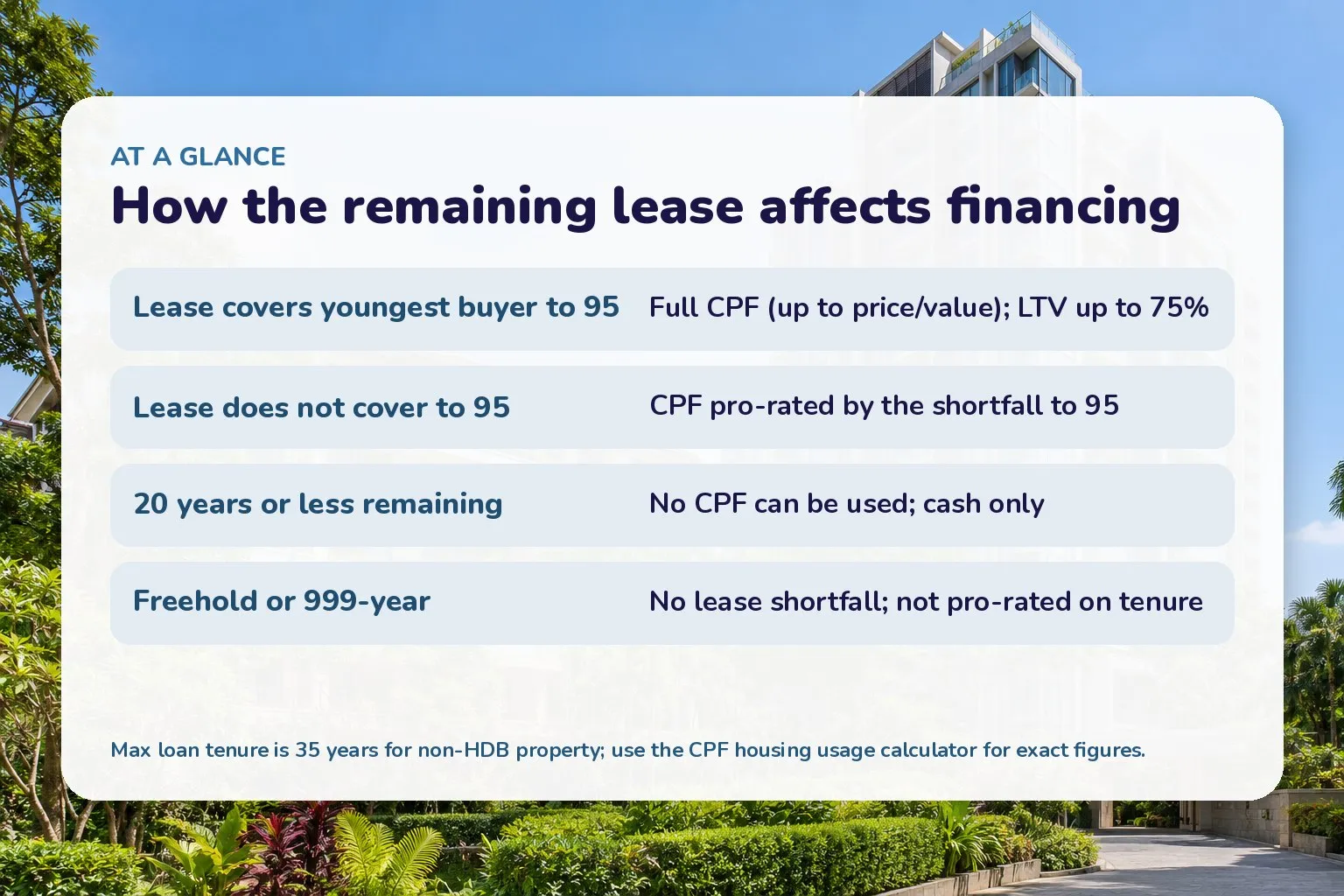
CPF. Since 10 May 2019, the key test for CPF use on any property — including private — is whether the remaining lease covers the youngest buyer using CPF to age 95. If it does, you can use your CPF Ordinary Account up to the lower of the purchase price or valuation. If it does not, CPF use is pro-rated by how far the lease reaches toward 95, and once you hit that capped amount you cannot use more CPF even if you have set aside your Basic Retirement Sum. There is a hard floor: the lease must have more than 20 years left for any CPF to be used.
Loans. The maximum housing-loan tenure is 35 years for non-HDB properties (30 for HDB). For a borrower with no other home loan, the loan-to-value limit is up to 75%, but it drops to 55% if the tenure runs beyond 30 years or past your 65th birthday — which an older buyer on a shorter-lease unit can trigger.
Freehold (and 999-year) land sidesteps the lease side of all this: there is no remaining-lease shortfall to pro-rate, so a freehold home never fails the age-95 test on tenure grounds. On a leasehold, a buyer in their 30s eyeing an older unit can find CPF and loan both pinched.
The price gap: what you pay for perpetuity
Freehold homes have long traded at a premium to comparable leasehold units — the buyer is paying for permanence and scarcity. The premium is widest in prime central districts, where freehold stock is concentrated, and narrower in the suburbs. It is not fixed: market reports through 2026 show the gap narrowing on new launches as leasehold prices climbed.
Because the premium swings with district, project age and demand, there is no single official “freehold is X% dearer” figure. Rather than trust a headline number, compare the actual transacted prices of freehold and leasehold units of similar age, size and location on URA’s data and REALIS before you decide whether the premium is worth it for your case.
Can you extend a leasehold?
Sometimes — but it is neither automatic nor cheap. For leasehold land, topping up the lease (for example back toward a fresh 99 years) requires paying the State a land premium, which the SLA computes using the same Leasehold Table. Approval is assessed case by case against the Government’s long-term planning intentions for the site, so it is never guaranteed. In practice, most leasehold homeowners simply ride the lease down rather than extend it, which is why the remaining lease at your intended exit — not just today — is the number that matters.
Which tenure should you choose?
Map the tenure to your plan:
- Long hold or legacy (20+ years, passing it on): freehold is the pick. No decay, scarcity support, and the strongest very-long-term asset. A 999-year leasehold is a close substitute if the freehold premium is steep.
- First home or tighter budget, 7–15 year horizon: a well-located 99-year leasehold is the sharper buy. Lower entry price, and early-life appreciation tends to track location and demand more than tenure. Just mind the lease at resale.
- Older buyer, central location, clear-eyed about value: either can work — but on a shorter-lease unit, confirm your CPF and loan limits first, and do not pay a near-freehold price for a decaying lease.
The mistake to avoid at both ends: overpaying for a freehold you will sell in five years, or buying an ageing leasehold whose financing and resale pool are already shrinking. Let your horizon, budget and the remaining lease decide together. If you are also weighing an executive condominium, see EC versus condo.
Frequently asked questions
Is freehold always a better investment than leasehold? Not always. Freehold resists lease decay and tends to win on a long hold, but a cheaper, well-located 99-year unit can post stronger early percentage gains. The best choice depends on your holding period and entry price.
What happens when a 99-year lease ends? The land reverts to the State and the owner receives no payout. In practice buyers rarely hold to expiry; value and financing tighten long before then as the lease shortens.
Does the Government ever take back freehold land? Yes. Even freehold and 999-year land can be compulsorily acquired by the State under the Land Acquisition Act, with compensation. Freehold is perpetual ownership, not immunity from acquisition.
Is a 999-year lease worth less than freehold? In valuation terms the difference is negligible — banks and valuers treat 999-year as effectively freehold. True freehold may still carry a small premium for buyers who want absolute ownership.
Related
- HDB lease decay and your flat’s value
- Private property vs HDB: the true cost
- Executive condo (EC) vs condo
- TDSR and MSR debt limits explained
General information, not financial or property advice. Confirm your CPF and loan limits with the official calculators and verify transacted prices on URA before committing.
Sources
- Determining the Value of Leasehold Land: A Closer Look at Bala's Table (SLA Leasehold Table) — Singapore Land Authority / Centre for Liveable Cities (as of November 2026)
- How much CPF savings you can use for your home purchase — Central Provident Fund Board (as of November 2026)
- More Flexibility to Buy a Home for Life While Safeguarding Retirement Adequacy — Ministry of National Development / Ministry of Manpower (as of November 2026)
- Loan Tenure and Loan-to-Value Limits — Monetary Authority of Singapore (as of November 2026)
- Private Residential Properties (transaction data) — Urban Redevelopment Authority (as of November 2026)