HDB Lease Decay and Your Flat's Value
HDB lease decay is the gradual fall in a flat's value as its 99-year lease runs down; at expiry the flat returns to HDB worth nothing. It bites through financing — CPF use and loan limits shrink once the remaining lease cannot cover the youngest buyer to age 95.
On this page9 sections · tap to jump
- 01What lease decay is
- 02What happens when the lease runs out
- 03The age-95 rule: the financing hinge
- 04CPF usage shrinks as the lease shortens
- 05Loan limits: LTV and tenure
- 06How lease decay shows up in value
- 07SERS and VERS are not a safety net
- 08What to check before you buy an older flat
- 09Frequently asked questions
Every HDB flat is sold on a 99-year lease, and that clock never stops. As the remaining lease shortens, the flat gets harder to finance and, eventually, worth less — a slow process known as lease decay. For most buyers the pain is not in some distant expiry date but much sooner, at the points where CPF rules and loan limits tighten. This guide explains how decay works, when it starts to bite, and what to check before buying an older flat.
What lease decay is
Lease decay is the decline in a leasehold flat’s value as its remaining lease runs down toward zero. A brand-new flat has close to 99 years left; a flat bought second-hand in the 1990s may now have 60-odd years. Because the land is only leased from the State, the value of that lease naturally erodes over time — and the erosion speeds up as the lease gets short, because buyers, CPF rules and banks all treat a short-lease flat more cautiously.
It is not a defect or a scandal; it is how leasehold works, and it was flagged from the start. In a 1994 parliamentary reply the Government noted that resale buyers “should know the expiry date of the flats’ leases; the price they pay for the lease takes into account the remaining lease period.” In other words, a shorter lease is supposed to mean a lower price.
What happens when the lease runs out
At the end of the 99 years, the flat returns to HDB and the land reverts to the State — with no payout to the owner. The same 1994 reply is blunt: “Under the lease contract, HDB would not need to pay lessees any compensation when their leases expire.” The flat’s value at that point is, in effect, zero.
No HDB flat has actually reached expiry yet — the scheme only began in the 1960s — so this is a contractual and policy outcome rather than something observed in practice. But the direction of travel is official: as the then National Development Minister put it, for most flats “the land will return to the State at the end of 99 years,” and young couples were advised to buy “a home that covers you and your spouse to age 95.”
The age-95 rule: the financing hinge
Since 10 May 2019, the key question for financing an HDB flat has not been the raw number of years left, but whether the remaining lease can cover the youngest buyer using CPF to at least age 95. The Ministry of Manpower explained that “the rules will now focus on whether the remaining lease of the home can cover the youngest buyer until at least the age of 95.”
This single test decides how much CPF you can use and how big a loan you can take. It is why two buyers looking at the same flat can face very different limits: a 30-year-old needs the lease to last 65 more years to reach 95, while a 55-year-old needs only 40. The younger you are, the more easily an older flat falls short.
CPF usage shrinks as the lease shortens
If the remaining lease covers the youngest buyer to 95, you can use your CPF Ordinary Account up to the lower of the purchase price or the valuation — the full amount most buyers expect. If it does not, CPF use is pro-rated. The CPF Board states that where the lease cannot reach the youngest buyer to 95, “you… can use your respective OA savings up to a percentage of the lower of the purchase price or the valuation price.”
There is a hard floor: the flat must have more than 20 years of lease remaining for any CPF to be used. Below that, you fund the purchase entirely in cash. The CPF Board gives a concrete illustration of pro-rating: two 25-year-olds buying a flat with 65 years of lease left for S$550,000 can use up to S$495,000 — 90% — “because the lease will only last until they are 90 years old.”
Loan limits: LTV and tenure
Lease decay squeezes loans on two fronts. First, the loan-to-value (LTV) limit. For an HDB housing loan, if the lease covers the youngest core member to 95, the LTV is 75% of the lower of resale price or value; otherwise it is “pro-rated from 75%.” That 75% ceiling itself is recent — HDB cut the LTV from 80% to 75% on 20 August 2024 as a cooling measure, bringing it in line with bank loans, which were already at 75%.
Second, the loan tenure. HDB caps it at the shortest of three numbers: 25 years, 65 minus the buyers’ average age, or the remaining lease minus 20 years. On an old flat the “lease minus 20” term often wins, cutting the tenure sharply and pushing up the monthly instalment.
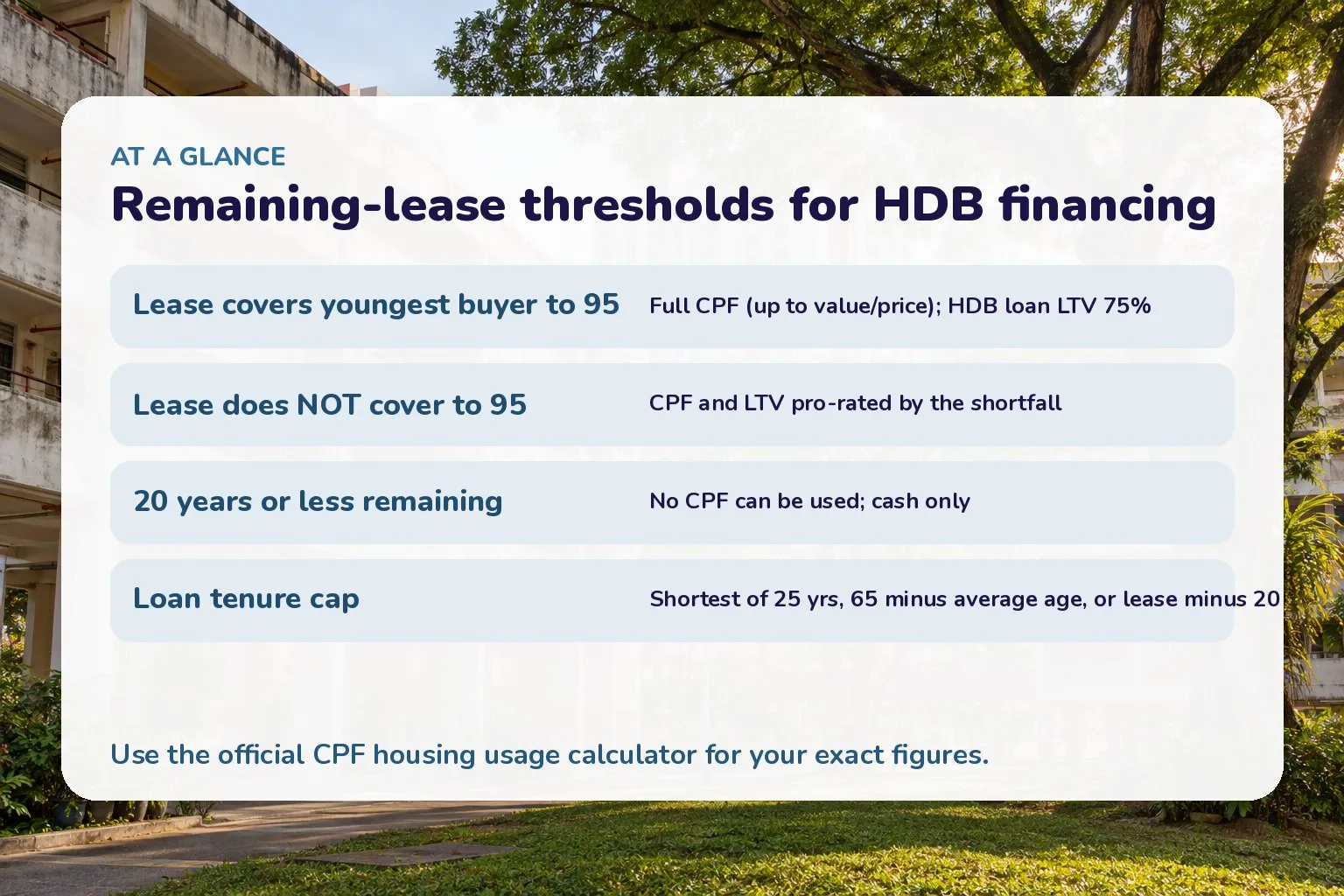
Key remaining-lease thresholds for HDB financing. Source: CPF Board, HDB and MOM/MND, as of November 2026.
A bank loan does not escape the age-95 test for CPF — the CPF limit is pro-rated the same way regardless of lender. A bank may offer its own tenure, but the CPF pro-rating and the cash shortfall it creates still apply. If you are weighing lenders, see HDB loan vs bank loan; and because a shorter tenure means larger instalments, check how that interacts with the TDSR and MSR debt limits.
How lease decay shows up in value
Because price is meant to reflect the remaining lease, flats with shorter leases generally sell at a discount to otherwise-similar newer flats, and the gap tends to widen as the lease shortens and financing restrictions kick in. Two linked effects drive this: the asset simply has fewer years left, and the pool of buyers who can finance it shrinks — younger buyers are pushed out by the age-95 test, and below 20 years’ lease the cash-only rule removes almost everyone.
This is why an older flat in a central, convenient location can still command a high price today yet be a riskier long-term hold: the convenience supports demand now, but the lease keeps running. When you price a resale flat, the remaining lease is one of the first things a realistic valuation has to weigh.
SERS and VERS are not a safety net
Many owners hope the Selective En bloc Redevelopment Scheme (SERS) will rescue an ageing flat with fresh compensation and a new unit. It can — but only for a tiny minority. The Government has repeatedly stressed that SERS “will not apply to all flats, only a few”; the overwhelming majority of flats will simply run down their leases. Treating SERS as a guaranteed exit is a mistake. The newer Voluntary Early Redevelopment Scheme (VERS) is still being developed and is likewise not a promise of full value.
What to check before you buy an older flat
Before committing to a flat with a noticeably shorter lease, run through the essentials:
- The exact remaining lease, from the HDB Map, and whether it covers the youngest buyer to 95.
- Your CPF limit and loan, using the official CPF housing usage calculator — not an assumption that you can use CPF and borrow in full.
- The cash shortfall you would need to top up if CPF and the loan are pro-rated.
- Your exit: who could buy this flat from you in 10–15 years, and at what lease. Confirm you also meet the basic resale eligibility conditions, and weigh the trade-offs in BTO vs resale.
Frequently asked questions
At what remaining lease do problems start? There is no single number — it depends on your age. The practical triggers are the age-95 coverage test, the 20-year floor below which no CPF can be used, and the point where the “lease minus 20” tenure cap shortens your loan.
Can I use any CPF on a flat with 18 years left? No. CPF can only be used when the flat has more than 20 years of lease remaining. Below that, the purchase and any instalments must be paid in cash.
Does a bank loan get around the age-95 rule? Not for CPF. The CPF usage limit is pro-rated the same way whatever the lender, so a bank loan does not remove the cash shortfall a short lease creates.
Will the Government compensate me when the lease ends? No. Under the lease contract HDB pays no compensation at expiry; the flat returns to HDB and the land to the State.
Related
- BTO vs resale flat: which should you choose?
- HDB loan vs bank loan compared
- Who can buy an HDB resale flat?
- How to price your resale flat
General information, not financial or property advice. Confirm your CPF and loan limits with the official CPF housing usage calculator and HDB.
Sources
- How much CPF savings you can use for your home purchase — Central Provident Fund Board (as of November 2026)
- How much CPF savings can I use if the lease does not cover the youngest buyer to age 95? — Central Provident Fund Board (as of November 2026)
- More Flexibility to Buy a Home for Life While Safeguarding Retirement Adequacy — Ministry of Manpower / Ministry of National Development (as of November 2026)
- Measures to Cool the HDB Resale Market and Provide Greater Support for First-time Home Buyers — Housing & Development Board (as of November 2026)
- Mode of Financing for a Resale Flat — Housing & Development Board (as of November 2026)
- Parliamentary reply: compensation on expiry of HDB 99-year leases — Government of Singapore (as of November 2026)