Rental Income Tax in Singapore for Landlords
Rental income in Singapore is taxed under personal income tax on your net rent — gross rent minus allowable expenses — at your progressive resident rate. You can deduct actual expenses, or claim a 15% deemed amount plus mortgage interest.
On this page11 sections · tap to jump
- 01What counts as rental income
- 02You are taxed on net rent, not gross
- 03Claiming expenses: actual or the 15% deemed option
- 04What you can and cannot deduct
- 05Who is taxed: sole versus joint owners
- 06What rate you pay
- 07If you are a non-resident landlord
- 08Reporting, deadlines and telling IRAS
- 09Rental losses
- 10A worked example
- 11Frequently asked questions
If you rent out a flat or condo in Singapore, the rent is income — and IRAS taxes it. Yet it works nothing like the annual property tax bill most owners already know. This guide explains exactly how rental income tax works: what counts as rent, how to turn gross rent into the taxable net figure, what you can and cannot deduct, who is taxed when a property is shared, the rate you pay, and how to file without getting the penalty. Every rule here is the official IRAS position, dated.
What counts as rental income
Rental income is the full amount of rent and related payments you receive for letting out your property — not just the base rent. IRAS counts all of the following as taxable rental income:
- Rent of the premises;
- Maintenance you charge the tenant;
- Rent of furniture and fittings;
- A rental deposit you forfeit (generally treated as part of gross rent — though if it is forfeited to repair tenant damage, you may claim the repair cost as an expense);
- Income from subletting a room while you still live there;
- Any amount you recover from insurance on the rented-out property.
So the figure you declare starts from everything the tenancy brings in, before you subtract a single cost.
You are taxed on net rent, not gross
You are not taxed on the headline rent. Only the net rental income — gross rent minus allowable expenses — is subject to income tax. That net figure is then added to your other income (salary, trade income) and taxed at your personal rate.
One timing rule catches people out: rental income is taxable from the date it is due and payable to you, not the date you actually receive it. IRAS’s own example: if a tenant rents from October to December 2025 but only pays in January 2026, you declare that rent for the Year of Assessment 2026 — because it was due in 2025.
Claiming expenses: actual or the 15% deemed option
For a tenanted residential property you have two ways to claim expenses.
Actual expenses. Add up every allowable cost and keep the receipts — tenancy agreements, bank mortgage statements, invoices — for at least five years in case IRAS checks.
Deemed expenses (the simpler route). IRAS pre-fills your rental expenses at a flat 15% of gross rent. On top of that 15% you may still claim your mortgage interest. You do not need to keep records of the other expenses — only the mortgage-interest documents, for five years. For a landlord whose real running costs are modest, the 15% deemed amount often beats tallying actual receipts.
| Actual expenses | 15% deemed expenses | |
|---|---|---|
| What you deduct | Every allowable cost you incurred | 15% of gross rent, plus mortgage interest |
| Records to keep (5 years) | All invoices, receipts, statements | Mortgage-interest documents only |
| Best when | Real costs exceed 15% of rent | Real costs are low or hard to document |
What you can and cannot deduct
If you claim actual expenses, the line between allowable and non-allowable matters:
Allowable (incurred to earn the rent, during the tenancy):
- Mortgage interest on the loan taken to buy the rented property;
- Property tax paid for the rental period;
- Fire insurance premiums;
- Repairs that restore the property to its original state;
- Maintenance — painting, pest control, monthly maintenance (MCST) charges;
- Costs of securing a tenant — agent’s commission, advertising, legal fees and stamp duty (for the first and subsequent tenants, from the Year of Assessment 2022);
- Property management / supervision fees;
- Replacing worn furniture or appliances to their original state;
- Utilities or internet you pay for the tenant and are not reimbursed for.
Not allowable:
- The principal portion of your loan repayment (only the interest counts);
- Initial repairs, and any renovation, improvement, addition or alteration;
- Depreciation of furniture and appliances;
- Penalties for late or non-payment of property tax;
- Costs on a property that is not generating rental income;
- Utilities the tenant reimburses to you.
From the Year of Assessment 2022, costs incurred while the property is vacant between leases — repairs, insurance, maintenance, property tax — are deductible too, provided you made reasonable efforts to find a new tenant.
Who is taxed: sole versus joint owners
Who signs the tenancy or collects the money does not decide who is taxed.
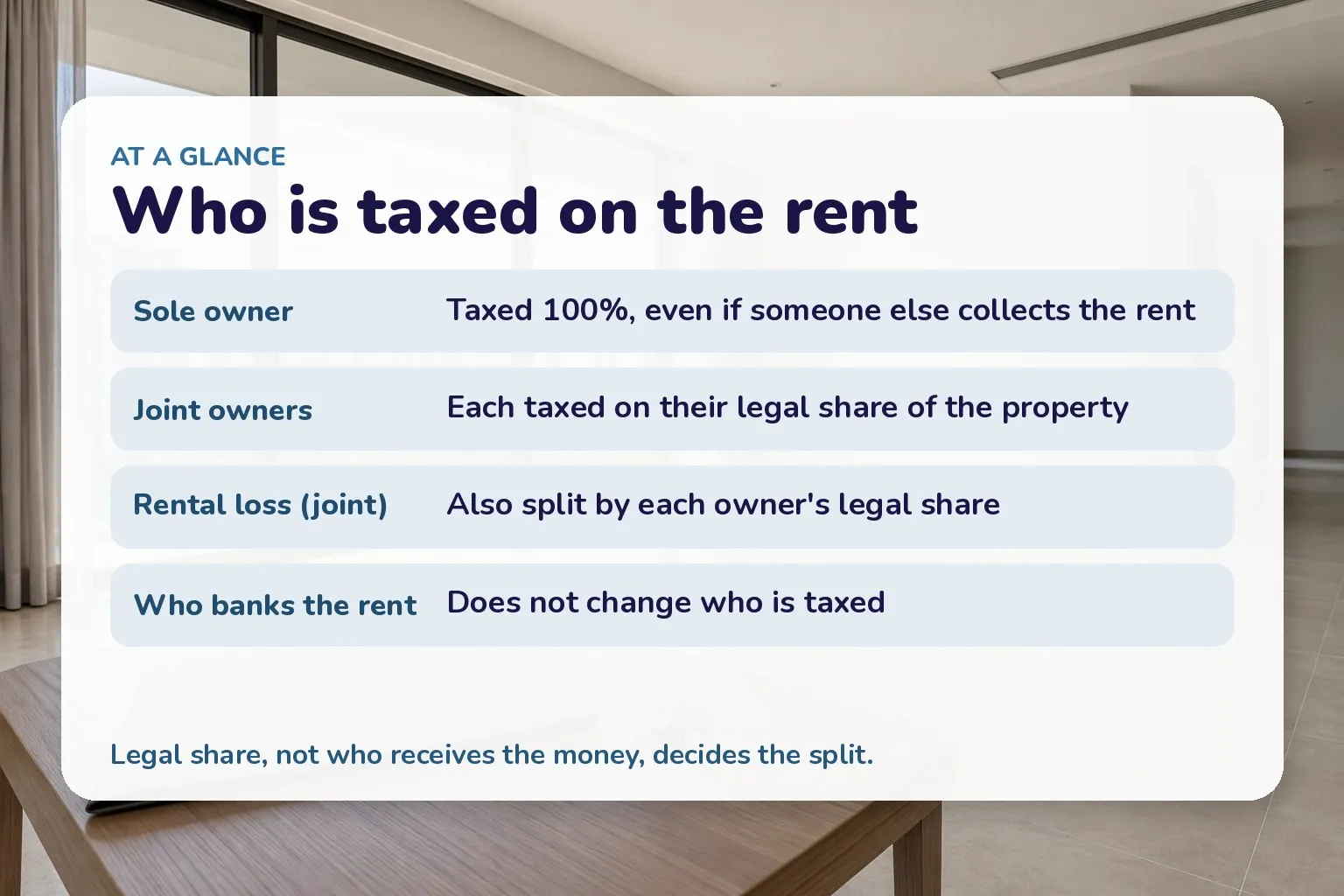
How rental income is split between owners.
- Sole ownership: the rental income is taxed 100% on the sole owner, even if a third party receives the rent.
- Joint ownership: the income is taxed on all joint owners by their legal share in the property. It does not matter who banks the rent or who paid for the property. A rental loss is split the same way.
So a couple who own 50:50 each declare half the net rent, regardless of whose bank account the tenant pays into.
What rate you pay
Rental income is not taxed at a special rate. Your net rent is added to your other income and taxed at Singapore’s progressive resident rates, which from the Year of Assessment 2024 run from 0% on the first S$20,000 of chargeable income up to 24% on chargeable income above S$1,000,000. Where your rental income lands depends entirely on your total income.
| Chargeable income (first / next) | Marginal rate |
|---|---|
| First S$20,000 | 0% |
| Next S$10,000 (to S$30,000) | 2% |
| Next S$10,000 (to S$40,000) | 3.5% |
| Next S$40,000 (to S$80,000) | 7% |
| Next S$40,000 (to S$120,000) | 11.5% |
| … rising to above S$1,000,000 | 24% |
Because it stacks on top of your salary, an extra S$30,000 of net rent is taxed at your marginal rate — the band your income has already reached — not from zero.
If you are a non-resident landlord
Your residency decides the rate. You are a tax resident if you are a Singapore Citizen or PR residing here, or a foreigner who stayed or worked in Singapore for at least 183 days in the previous calendar year. If you fall short of that — for instance you have moved abroad but kept the condo — you are a non-resident, your net rental income is taxed at the prevailing non-resident rate (24% from the Year of Assessment 2024), and you do not get personal reliefs. Non-resident landlords should confirm their exact position, and any collection arrangement through a tenant or agent, directly with IRAS.
Reporting, deadlines and telling IRAS
Declare your rent under “Other Income: Rent from property” in your Income Tax Return, giving the total annual rent, total deductible expenses, and your share of the rent if the property is jointly owned. IRAS pre-fills much of this from e-Stamping records, but the onus is on you to correct it. Individual tax returns are due by 15 April (paper) or 18 April (e-filing) each year.
Separately, when you first let the property, you must inform IRAS within 15 days of the letting for property tax purposes — but this happens automatically when your tenancy agreement is e-Stamped through myTax Portal, so you usually need not notify IRAS separately. The penalty for not notifying is a fine of up to S$5,000 plus interest.
If you under-declared in the past, IRAS may waive the penalty if you make a voluntary disclosure within a one-year grace period from the filing deadline.
Rental losses
If allowable expenses exceed the rent, you have a rental loss. That loss cannot be carried forward and cannot be set against other income such as your salary. The one concession: you may use a rental loss on one property to offset taxable rental income from another property in the same year, provided all the properties are rented out at market rates.
A worked example
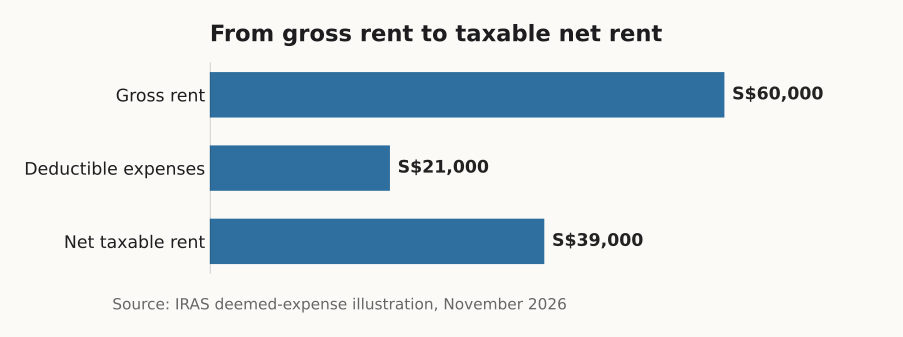
Illustrative: S$5,000/month rent, S$12,000 mortgage interest plus 15% deemed expenses.
Renting out just a room works the same way on a smaller scale: if you sublet one of three bedrooms at S$600 a month (S$7,200 a year), the deemed deduction is 15% (S$1,080) plus a one-third share of the mortgage interest, and you are taxed on the balance. You can also weigh these numbers against the full picture in our guide to renting out an HDB flat.
Frequently asked questions
Is a forfeited rental deposit taxable? Generally yes — a forfeited deposit is treated as part of your gross rent. The exception is where you forfeit it to repair damage the tenant caused; then you may claim the repair cost as an expense.
Do I pay tax on rent if I only sublet one room? Yes. Subletting income is taxable. You apportion expenses by the number of rooms rented out, or use the 15% deemed method plus apportioned mortgage interest.
Am I being taxed twice — income tax and property tax? No. Property tax is charged on owning the property; income tax is charged on the rent you earn. They are different taxes, and the property tax paid during the rental period is a deductible expense against the rent.
How long must I keep records? At least five years, whether you claim actual expenses (all receipts and statements) or deemed expenses (your mortgage-interest documents).
Related
- Property tax in Singapore explained
- Renting out an HDB flat: rules and costs
- Tenancy agreements and deposits
- Best home loan rates compared
General information to help you understand how rental income is taxed, not tax advice. Confirm your own figures and filing with IRAS.
Sources
- Income from property rented out — Inland Revenue Authority of Singapore (as of November 2026)
- Renting out your Property — Inland Revenue Authority of Singapore (as of November 2026)
- Individual Income Tax rates — Inland Revenue Authority of Singapore (as of November 2026)
- Property Tax on Residential Property — Government of Singapore (as of November 2026)