Loan-to-Value (LTV) Limits Explained

The loan-to-value (LTV) limit caps how much you can borrow for a home. For a first housing loan the ceiling is 75% of price or value; it falls to 55% for long tenures or older borrowers, and drops further if you already hold home loans.
On this page9 sections · tap to jump
The loan-to-value (LTV) limit caps how much you can borrow against a property. For a first housing loan the ceiling is 75% of the price or value, which means a minimum 25% downpayment; it falls to 55% for long loan tenures or older borrowers, and drops further once you already carry one or more home loans. LTV is set by the Monetary Authority of Singapore (MAS) for bank loans and mirrored by HDB for its own loan. This guide works through each tier, the cash you must put down, and how age and tenure change the figure.
What the LTV limit is
MAS defines it plainly: the “LTV limit determines the maximum amount an individual can borrow from a financial institution (FI) for a housing loan”, expressed as the loan as a percentage of the property’s value. Its own worked illustration: borrow $150,000 against a property valued at $1,000,000 and the LTV is 15%. The grid below applies to residential-property loans where the Option to Purchase is granted on or after 6 July 2018.
The LTV limit decides the size of your loan and therefore your downpayment. It does not, on its own, decide the monthly instalment — two separate rules do that, which we come to at the end.
LTV for a first housing loan
With no other outstanding housing loan, the limit is 75% or 55%. The 75% ceiling is the usual case; the 55% applies in the situations described further down. So a buyer with no existing mortgage normally funds a 25% downpayment and borrows the remaining three-quarters.
Downpayment: cash versus CPF
At the 75% ceiling the minimum cash downpayment is 5%; at the 55% ceiling it is 10%. The rest of the downpayment can come from your CPF Ordinary Account or cash. CPF confirms OA savings “can also be used for downpayment and housing loan taken for the property purchase, stamp and legal fees”, so for most bank-loan buyers only a small slice of the 25% has to be cash.
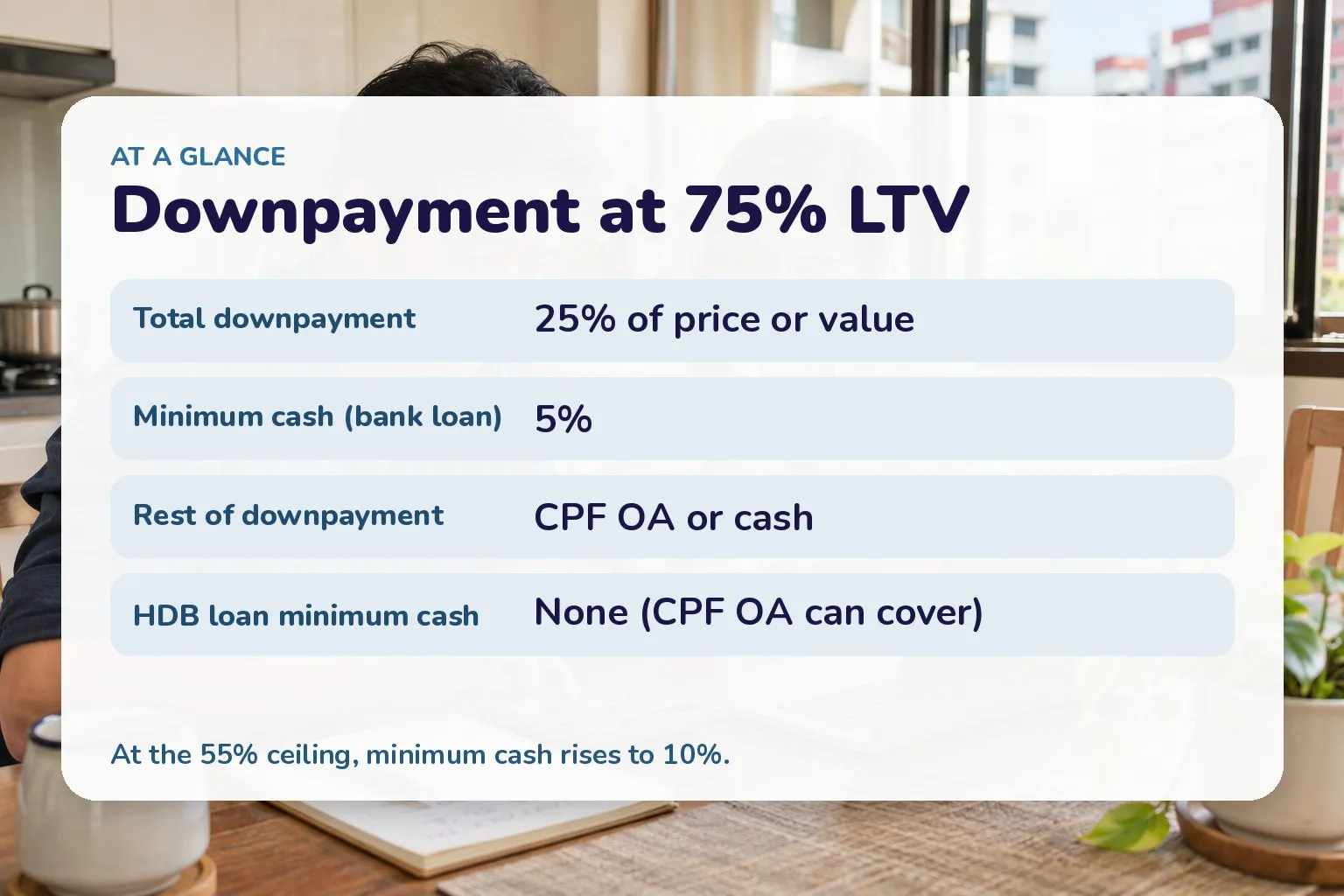
How the 25% downpayment splits between cash and CPF. Source: MAS / HDB, November 2026.
The HDB concessionary loan works differently on cash. It also lends up to 75%, but for a BTO flat the 10% due when you sign the Agreement for Lease “can be paid in full using your CPF Ordinary Account (OA), with cash, or with a combination of both. No minimum cash payment is required.” The trade-off is that you must use your CPF OA savings — you may retain up to $20,000 per buyer — before the HDB loan is granted. For a bank loan on a new flat the 20% due at the Agreement for Lease needs at least 5–10% in cash. The full comparison is in our HDB loan vs bank loan guide, and using CPF to buy a flat covers what your OA can and cannot fund.
LTV with existing housing loans
The ceiling drops sharply once you already service a mortgage, because “the LTV limits for individuals change depending on the number of outstanding housing loans a borrower has”:
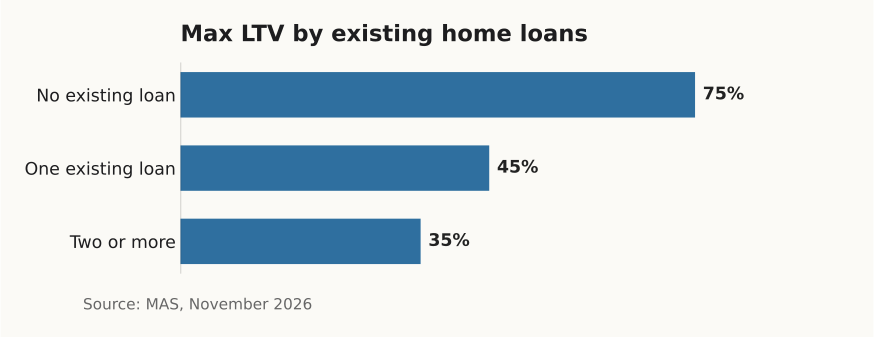
The higher figure in each tier; the lower tier applies for long tenures or older borrowers.
| Outstanding housing loans | LTV limit | Minimum cash downpayment |
|---|---|---|
| None | 75% or 55% | 5% (at 75%) or 10% (at 55%) |
| 1 | 45% or 25% | 25% |
| 2 or more | 35% or 15% | 25% |
So a second property bought while the first loan is still running caps borrowing at 45% (or 25%), and a third at 35% (or 15%) — each requiring 25% of the price in cash, not merely 5%. That cash hurdle, on top of Additional Buyer’s Stamp Duty, is what makes a second property far harder to finance than the headline price suggests.
When the limit drops to the lower tier
The lower figure in each tier is not optional. MAS says apply the lower LTV limit “if the loan tenure exceeds 30 years (or 25 years for HDB flats), or the loan period extends beyond the borrower’s age of 65 years.” In other words, stretch the tenure long or borrow into later life and your first-loan ceiling becomes 55%, not 75% — lifting the minimum cash to 10%.
Maximum tenure is itself capped: 30 years for HDB flats and 35 years for non-HDB properties. The practical lesson is that pushing the tenure to its limit to lower the instalment can quietly cost you LTV, forcing a larger downpayment.
How joint borrowers are assessed
Buying with a partner or family member? MAS uses the “income-weighted average age” of joint borrowers, not the elder’s age. Its example: a 60-year-old earning $8,000 and a 30-year-old earning $10,000 have an income-weighted average age of 43.34, because the younger, higher-earning borrower pulls the figure down. A younger, higher-earning co-borrower can therefore keep you in the 75% tier that the older borrower alone would miss.
The HDB loan: 75% since August 2024
The HDB concessionary loan lends “up to 75% of flat purchase price for new flats like BTO and SBF, or up to 75% of resale price or value of resale flat (whichever is lower).” That 75% is recent. The HDB loan LTV “will be lowered from 80% to 75%” with effect from 20 August 2024, applying to complete resale applications received on or after that date; the bank-loan limit was already 75% and did not change. The move brought the two loan types into line.
HDB also sizes the loan by your repayment period — the shortest of 25 years, 65 minus the average age of applicants, or the flat’s remaining lease minus 20 years — and caps the instalment at up to 30% of monthly income. A shorter remaining lease on an older resale flat can therefore pull down both the tenure and, through it, the loan. Our HDB lease decay guide explains how remaining lease feeds into financing.
LTV is not the only limit
LTV caps the loan size; two other MAS rules cap the monthly repayment. The Total Debt Servicing Ratio (TDSR) holds all your debt repayments to 55% of gross income, and the Mortgage Servicing Ratio (MSR) holds the housing loan alone to 30% for HDB flats and executive condominiums. You have to pass whichever rule is tighter, so a comfortable LTV does not guarantee the loan if your other debts are high. See TDSR and MSR limits explained for the repayment side, and put your own numbers through the affordability calculator. The full purchase cost, including stamp duty, is in the total cost of buying an HDB flat.
Frequently asked questions
What LTV applies if I buy through a company? If the borrower is a shell company or not an individual, the LTV limit is 15%.
Does the 75% apply to the price or the valuation? To the lower of the two. For a resale flat the bank or HDB lends against the purchase price or the valuation, whichever is lower, so any gap above valuation is paid in cash on top of the downpayment.
Why did my bank offer less than 75%? The lower 55% tier applies if your tenure exceeds 30 years (25 for an HDB flat) or the loan runs past age 65; existing housing loans cut it further to 45% or 35%.
Can CPF cover my whole downpayment? Only the non-cash part. At 75% LTV at least 5% of the price is cash for a bank loan; the rest can be CPF OA. An HDB loan requires no minimum cash.
Do these limits change the instalment? No — LTV sets the loan amount. The TDSR and MSR caps govern the monthly repayment.
Related
- TDSR and MSR limits explained
- HDB Flat Eligibility (HFE) letter explained
- HDB loan vs bank loan: which is cheaper?
General information, not financial advice. Figures are illustrative; check MAS, HDB and CPF for the current rules before you act.
Sources
- Loan Tenure and Loan-to-Value Limits — Monetary Authority of Singapore (as of November 2026)
- Housing Loans for HDB Flat Buyers — HDB (MyNiceHome) (as of November 2026)
- Measures to Cool the HDB Resale Market and Provide Greater Support for First-time Home Buyers — Housing & Development Board (as of November 2026)
- Using your CPF to buy a home — Central Provident Fund Board (as of November 2026)