ABSD on a Second Property in Singapore (2026 Rates)
A Singapore Citizen pays 20% Additional Buyer's Stamp Duty on a second residential property (Permanent Residents 30%, foreigners 60%), charged on the higher of price or market value. A married couple can claim it back by selling their first home within six months.
Buy a second home in Singapore and the big, often-overlooked cost is Additional Buyer’s Stamp Duty (ABSD) — a tax charged on top of the ordinary Buyer’s Stamp Duty, aimed at cooling investment demand. For a Singapore Citizen the second-property rate is 20% of the price, and it climbs steeply for Permanent Residents and foreigners. This guide sets out the 2026 rates, how IRAS decides it is your “second” property, what it costs on a real price, and the refund routes.
How ABSD works
ABSD is paid in addition to BSD, and both are worked out on the purchase price or the market value, whichever is higher. Your liability depends on two things as at the date of purchase: your buyer profile (citizen, PR, foreigner or entity) and the number of residential properties you already own. Try the figures first in our buyer’s stamp duty and ABSD calculator, then read on for the rules behind them.
ABSD is a buying tax, not a selling one — the duty you may owe when you sell early is Seller’s Stamp Duty, a separate charge. ABSD arises the moment you acquire, regardless of how long you later hold.
ABSD rates on a second property
The rates below took effect on 27 April 2023 and still apply in 2026. A Singapore Citizen pays nothing on a first home but 20% on a second; a Permanent Resident pays 5% on a first home and 30% on a second; a foreigner pays 60% on any purchase.
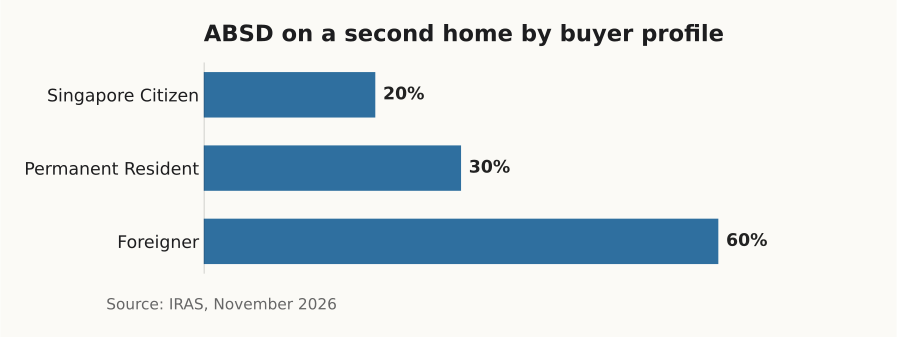
ABSD rates on a second residential property, on or after 27 April 2023. Source: IRAS, as of November 2026.
| Buyer profile | First property | Second property | Third and subsequent |
|---|---|---|---|
| Singapore Citizen | 0% | 20% | 30% |
| Singapore Permanent Resident | 5% | 30% | 35% |
| Foreigner | 60% | 60% | 60% |
| Entity / living trust | 65% | 65% | 65% |
A foreigner pays 60% from the very first home, and any entity (or a transfer into a living trust) pays 65%. For a joint purchase by buyers of different profiles, the highest applicable rate applies to the entire value — so a citizen buying with a foreigner spouse is charged at the foreigner rate on the whole property unless a remission applies.
How IRAS counts your properties
Whether a home is your “second” turns on the property count, and the rules are wider than many buyers expect.
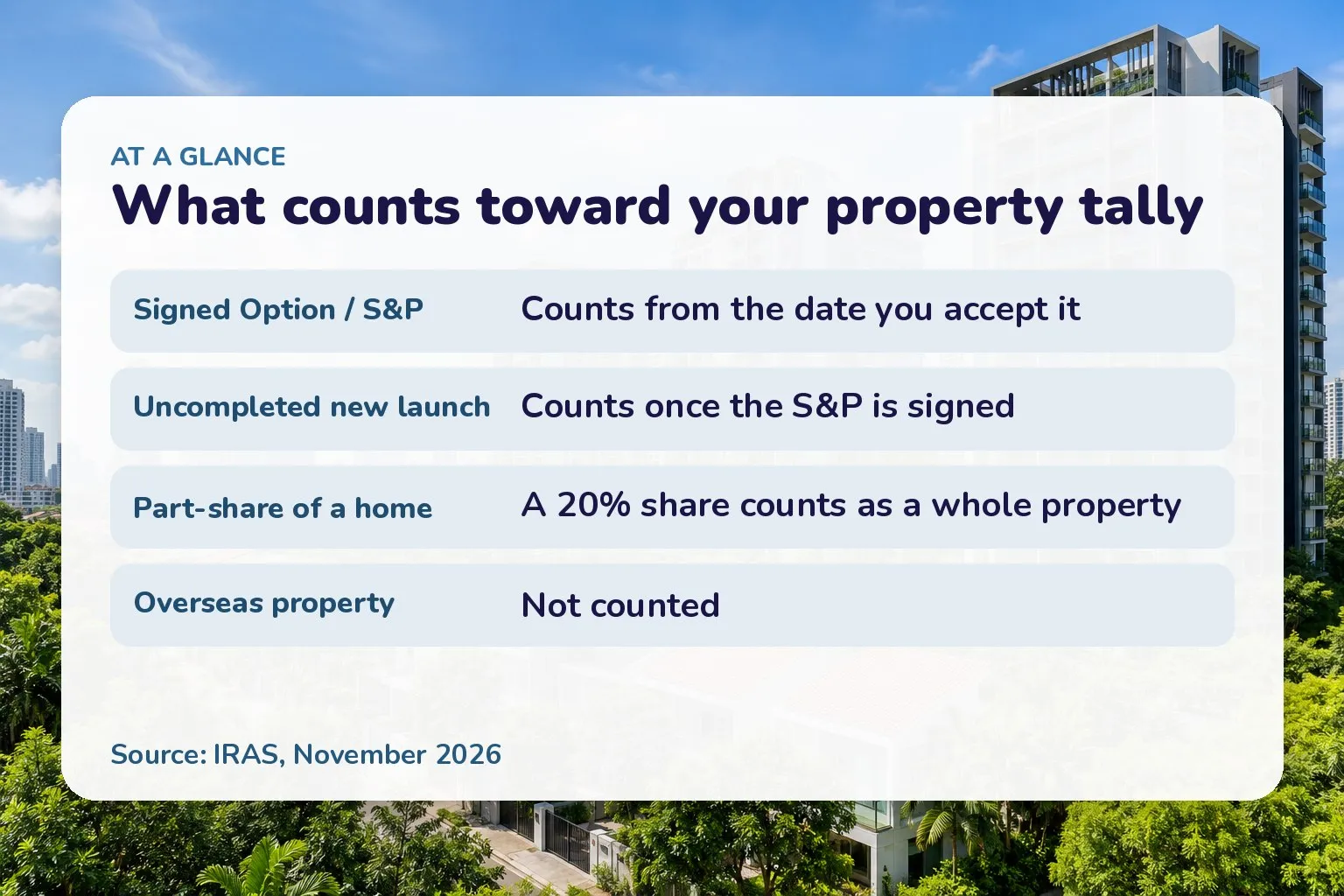
How IRAS decides whether a home is your second property.
- A signed contract counts immediately. Once you accept an Option to Purchase, that property is added to your count “even if it has not been legally transferred to him as he already has an equitable interest in the property.”
- An uncompleted unit counts. Buying a new launch from a developer is included once the Sale & Purchase Agreement has been signed — you do not wait for the building to finish.
- Any share counts as a whole. Owning a 20% slice of one flat with a sibling plus a home with your spouse means you are counted as owning two properties.
- Overseas homes are ignored. Only residential property located in Singapore is counted.
How the ABSD figure is worked out
ABSD is a percentage of the chargeable amount, rounded down to the nearest dollar, with a minimum duty of S$1. It sits on top of BSD, whose residential bands run 1% on the first S$180,000, 2% on the next S$180,000, 3% on the next S$640,000, 4% on the next S$500,000, 5% on the next S$1,500,000 and 6% above that.
For the same S$2,000,000 home, a Permanent Resident’s second-property ABSD would be 30% (S$600,000) and a foreigner’s 60% (S$1,200,000). Model your own price and profile in the ABSD calculator before you commit.
Paying the duty on time
Stamp duty is an upfront cost that cannot be deferred.
You may use CPF Ordinary Account savings to pay stamp duty, subject to the CPF housing scheme terms — but the money still leaves your account upfront, before any bank loan is drawn. IRAS also takes a hard line on avoidance: a contrived arrangement to reduce ABSD lets the Commissioner claw back the duty and add a 50% surcharge on the extra amount.
The married-couple refund
The most valuable relief lets a married couple upgrade without losing the ABSD on their new home.
A couple that includes a Singapore Citizen and owns no property can buy jointly with full remission — no ABSD at all — provided the home is in both their names only and neither owns any residential property.
Where the couple already owns one home and buys a second, they must pay the ABSD first and then claim it back, on these conditions:
- The property is bought in both spouses’ names only, and one is a Singapore Citizen.
- The first home is sold within 6 months of buying the second (or within 6 months of the TOP/CSC if the second home was uncompleted).
- The couple stays married, keeps the second home in the same names, and buys no other property in between.
There is also relief for people buying alone later in life: a single Singapore Citizen aged 55 and above who buys a second residential property on or after 16 February 2024 can claim a refund of the ABSD paid, subject to conditions. Both routes still require you to pay the ABSD upfront and sell the first home within the window.
How ABSD interacts with your loan
ABSD is separate from the loan limit, but they bite together. A second home usually comes with a tighter loan-to-value limit — a buyer with one outstanding housing loan can borrow only up to 45% (or 25% for a long tenure), against 75% on a first loan — so you are funding both a larger cash gap and a six-figure ABSD at the same time. Size the whole package, not just the duty, and compare the public vs private routes in our guides on private property vs HDB cost and executive condo vs private condo.
Frequently asked questions
Is ABSD payable on a property received as a gift? Yes. ABSD is still payable on a transfer by way of gift, calculated on the market value since there is no price. An inheritance that follows a Will, the Intestate Succession Act or Muslim inheritance law does not attract ABSD.
Do US citizens pay the foreigner rate? No. Under free-trade agreements, nationals of the United States, Iceland, Liechtenstein, Norway and Switzerland are accorded the same ABSD treatment as a Singapore Citizen — nothing on a first home, 20% on a second.
Can I avoid ABSD by buying only a share of the second home? No. Any interest you acquire counts, and a part-share is counted as a whole property for the count. “Decoupling” and part-share structures have their own stamp-duty consequences and anti-avoidance risk; check them with IRAS first.
Does buying an uncompleted new launch delay the ABSD? No. The purchase counts from the date you sign the Sale & Purchase Agreement, and the duty falls due within 14 days of signing — long before the building is finished.
Related
- New launch vs resale condo: which to buy
- Seller’s Stamp Duty (SSD) explained
- Property tax in Singapore explained
- TDSR and MSR loan limits explained
General information, not tax or legal advice. Confirm your own ABSD liability and any refund with IRAS or your conveyancing lawyer.
Sources
- Additional Buyer's Stamp Duty (ABSD) — Inland Revenue Authority of Singapore (as of November 2026)
- Remission of ABSD for a Married Couple — Inland Revenue Authority of Singapore (as of November 2026)
- Buyer's Stamp Duty (BSD) — Inland Revenue Authority of Singapore (as of November 2026)
- Loan Tenure and Loan-to-Value Limits — Monetary Authority of Singapore (as of November 2026)