New Launch vs Resale Condo: Which to Buy
Neither wins outright: buy a new launch for a brand-new unit, a fresh 99-year lease and payments spread across construction if you can wait three to four years. Buy resale to inspect the exact unit and move in or rent it out within months.
A new launch and a resale condo are two different buying experiences dressed up as the same purchase. A new launch is an uncompleted unit you buy from a licensed developer and pay for in stages as it is built; a resale is a completed unit you buy on the open market and pay for almost in full at completion. The right choice turns on your timeline, your cash flow and how much certainty you need.
Quick verdict
- Best for an upgrader who can wait: a new launch. You get a fresh 99-year lease, a brand-new unit, and payments spread across a three-to-four-year build, so your cash and CPF are not drained at once.
- Best if you need to move in or rent out soon: a resale. Completion takes a couple of months, not years, and you can inspect the exact unit — floor, view, condition, renovation — before you commit.
- Best for tight upfront cash: a new launch, because only about 20% is due in the first two months.
- Best for price certainty and no construction risk: a resale, where the home already exists and cannot be delayed.
There is no single winner. Below is the maths behind each use case.
The core difference
URA records private sales in three buckets — New Sale, Sub-Sale and Resale — and the label decides almost everything about how you pay. A new-launch unit is bought “off-plan”: you commit before the building exists and the developer draws your money in tranches tied to certified construction stages. A resale unit already stands, so you pay for it the way you would any completed property — a downpayment, then the balance at legal completion.
How you pay: progressive vs upfront
For a new launch, the Progressive Payment Scheme is prescribed in the standard Sale & Purchase Agreement under the Housing Developers Rules. You pay 20% of the price (including the booking fee) on signing or within 8 weeks of the Option, then instalments at each milestone: 10% on foundation work, 10% on the reinforced concrete framework, 5% on partition walls, 5% on roofing, and further 5% stages for services and external works.
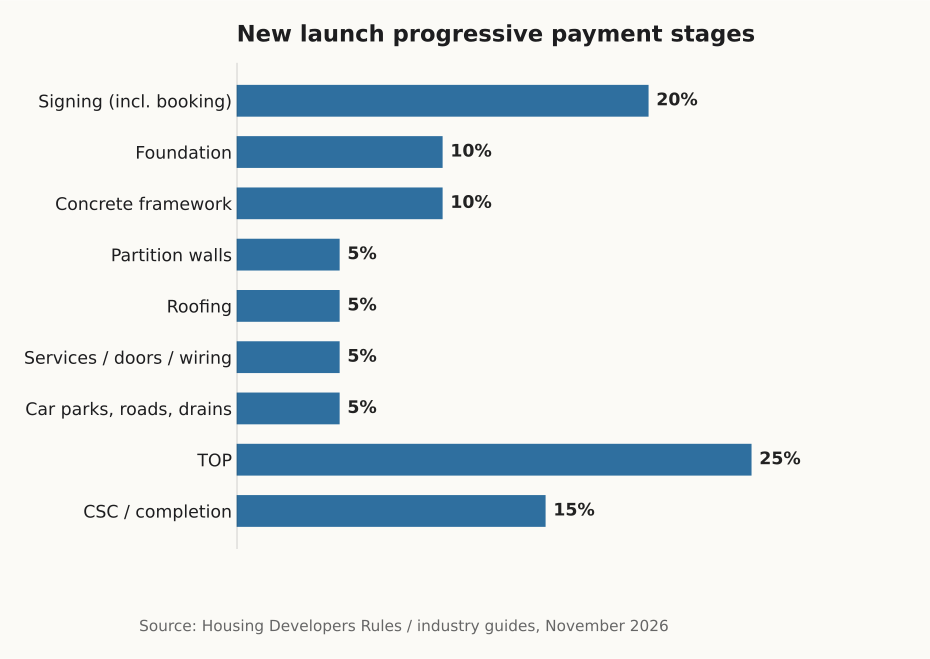
Progressive Payment Scheme stages as a share of the purchase price. The TOP and completion tranches are reported by industry guides; the earlier stages are set in the Housing Developers Rules. Source: Housing Developers Rules / industry guides, as of November 2026.
The two heaviest tranches come last: industry guides report 25% falling due at the Temporary Occupation Permit (TOP) and the final 15% at the Certificate of Statutory Completion (CSC) and legal completion. The stages add up to exactly 100% of the price.
A resale is funded under the normal payment scheme: industry guides describe a 25% downpayment paid upfront with the balance at legal completion, which typically takes about 8 to 12 weeks. There is no staging — the full loan is drawn near completion, so your mortgage instalments start at the full amount almost immediately.
| New launch (progressive) | Resale (normal) | |
|---|---|---|
| First outlay | ~20% within 8 weeks | 25% downpayment upfront |
| Rest of price | Drawn in stages over the build | Balance at completion (~8-12 weeks) |
| Loan drawdown | Stage by stage; small early instalments | Full loan drawn near completion |
| Loan type while building | Floating rate only | Any package; fixed available |
| Move in / rent out | After TOP (3-4 years) | Within a couple of months |
Timeline: waiting vs moving in now
This is the sharpest divide. Industry guides report that a mid-sized new-launch project typically takes three to four years from launch to completion. You cannot live in it, rent it out or collect a cent of rental income until TOP. A resale unit is ready — you can move in, or tenant it, within months of completion.
What prices are doing in 2026
Neither route is a guaranteed win in the current market. URA’s index shows the overall private residential price rose 0.5% in the second quarter of 2026, after 0.9% in the first — a cumulative 1.4% across the first half, below the 1.8% gain over the same period in 2025. Non-landed prices actually dipped 0.1% in the second quarter while landed rose 2.5%. The Q3 2026 flash estimate showed a 1.4% rise but with sale volume down about 30% quarter-on-quarter.
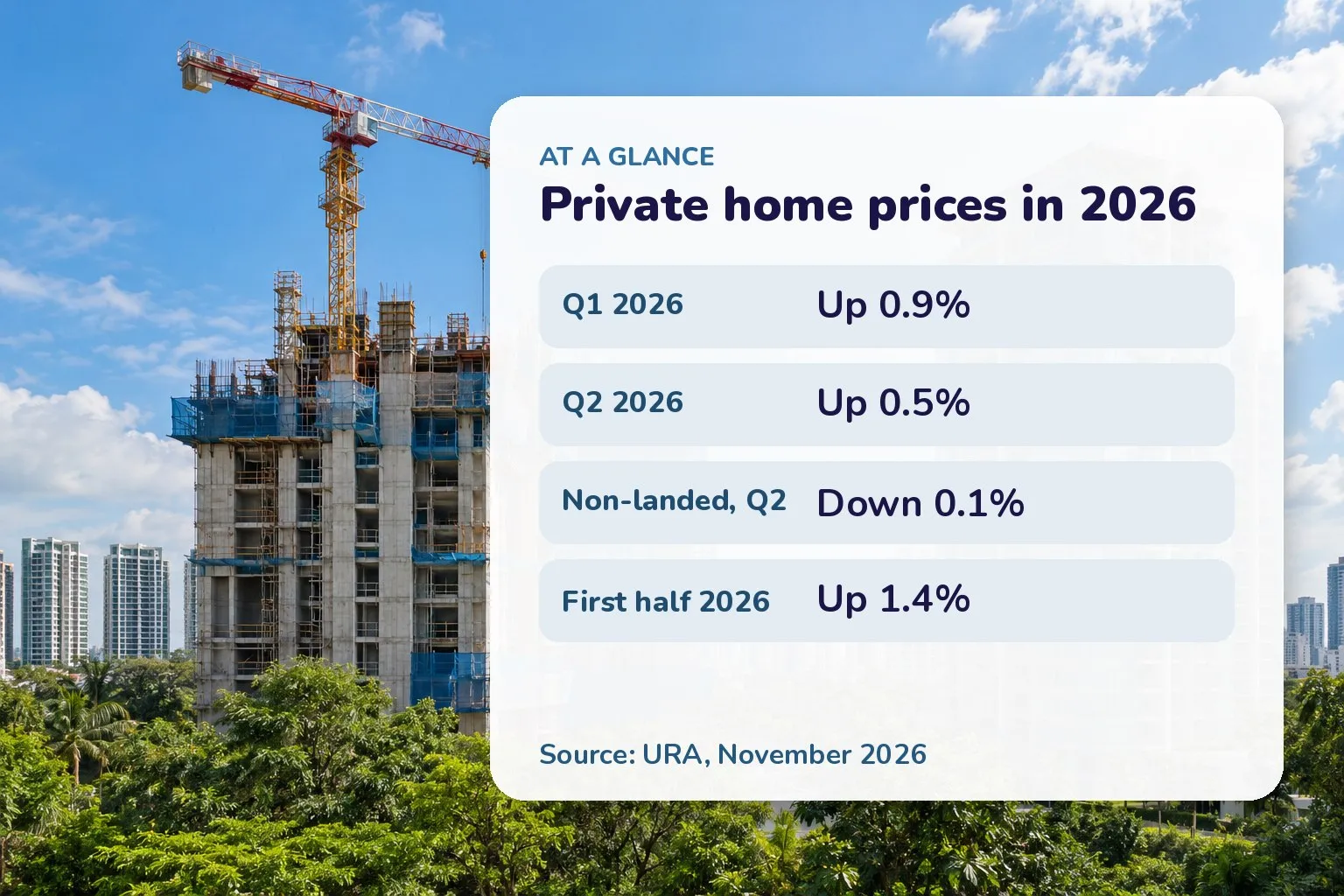
URA private residential property price index movements in 2026.
Supply is heavy: the Government’s Confirmed List puts 9,320 private units on the market for full-year 2026, and about 60,600 units are expected to complete over the next few years. More completed stock tends to widen resale choice and keep price growth in check — useful context whether you buy new or resale. You can browse the market yourself on our private home prices by district data page.
Stamp duty and loans are the same
The taxes do not change with the label. Buyer’s Stamp Duty and Additional Buyer’s Stamp Duty are charged the same way on a new launch and a resale — BSD on the first S$2,000,000 works out to S$69,600, and a second home attracts ABSD on a second property (20% for a citizen) on top. Both duties fall due within 14 days of signing the agreement, even for an uncompleted new launch.
The loan rules are identical too: a first housing loan is capped at a 75% loan-to-value limit with a minimum 5% cash downpayment, and the maximum tenure is 35 years for non-HDB property (a lower LTV applies if the tenure runs past 30 years or beyond age 65). The practical catch is the loan type: industry guides report that banks offer only floating-rate loans for an under-construction unit, and that you cannot refinance it until TOP — you can only reprice within the same bank. Compare packages in our guide to the best home loan rates.
The risks on each side
- New launch: construction delay, a showflat that flatters the real unit, GFA harmonisation (since 2024, voids and aircon ledges no longer count as saleable area, so compare like for like), and the floating-rate, no-refinance loan while you wait.
- Resale: an older lease that shortens your financing runway (see freehold vs leasehold), possible renovation or defects you inherit, and the full loan servicing starting straight away.
Who should pick which
Choose a new launch if you value a fresh 99-year lease and a never-lived-in unit, can wait three to four years, and want the staged payments to ease cash flow. Choose a resale if you need to move in or earn rent soon, want to see exactly what you are buying, or prefer the certainty of a home that already exists and cannot be delayed. Size the whole budget first with our private property vs HDB cost comparison before you decide.
Frequently asked questions
Is a new launch cheaper than a resale? Not necessarily. New launches are priced per project and often carry a premium for being brand-new, while resale prices are set by recent transactions. In 2026, non-landed prices were flat to slightly down, so compare actual per-square-foot prices for the specific area rather than assuming either is cheaper.
Can I use CPF for a new launch under progressive payment? Yes. CPF Ordinary Account savings can fund the downpayment portions and monthly instalments, subject to CPF housing rules, the same as for a resale. The 5% booking fee is usually required in cash.
Do I pay the full mortgage from day one on a new launch? No. Because the loan is drawn stage by stage, early instalments are small and grow as more of the loan is disbursed, reaching the full amount after the TOP and CSC tranches. On a resale the full loan is drawn near completion, so instalments start at the full amount.
Can I sell a new launch before it is completed? You can, as a sub-sale, but Seller’s Stamp Duty applies if you sell within the holding period, and the market for uncompleted units is narrower. Treat a new launch as a multi-year commitment, not a quick trade.
Related
- ABSD on a second property
- Executive condo vs private condo
- Private property vs HDB cost
- Freehold vs leasehold explained
General information, not property or financial advice. We do not represent buyers or sellers. Confirm figures with URA, IRAS and your conveyancing lawyer.
Sources
- Private Residential Properties (property data) — Urban Redevelopment Authority (as of November 2026)
- Release of 2nd Quarter 2026 real estate statistics — Urban Redevelopment Authority (as of November 2026)
- Release of flash estimate for 3rd Quarter 2026 private residential property price index — Urban Redevelopment Authority (as of November 2026)
- Housing Developers Rules (standard Sale and Purchase Agreement, payment schedule) — Singapore Statutes Online, Attorney-General's Chambers (as of November 2026)
- Loan Tenure and Loan-to-Value Limits — Monetary Authority of Singapore (as of November 2026)