Can Foreigners Buy Property in Singapore?
Yes — foreigners can buy private condominium and apartment units freely, but landed houses (including Sentosa Cove) need government approval, and an HDB flat generally needs permanent residency. Expect 60% Additional Buyer's Stamp Duty on top of normal stamp duty.
On this page11 sections · tap to jump
Yes, a foreigner buying property in Singapore can own a private home — but what you may buy, and whether you need permission first, depends on the property type. Condominiums and apartments are open to anyone; landed houses are tightly controlled; and the tax bill is far heavier than for a citizen. This guide sets out what you can buy, what needs approval, and the real cost once stamp duty is added.
The short answer
Under the Residential Property Act, administered by the Singapore Land Authority (SLA), a foreign person can buy a non-landed private home — a condominium or apartment unit — without any approval. Buying a landed house, including at Sentosa Cove, requires approval that is granted only in limited cases. HDB flats and executive condominiums are a separate matter, governed by HDB’s own rules rather than the Act.
Who is a “foreign person”
The Act defines this by exclusion. SLA states a “foreign person means any person who is not any of the following: Singapore citizen; Singapore company; Singapore limited liability partnership; or Singapore society.” Critically, a Singapore Permanent Resident (PR) is still a foreign person under the Act — PR status helps with HDB eligibility and stamp duty, but it does not by itself let you buy a landed house without approval.
What you can buy without approval
SLA lists the property types a foreign person “can purchase without approval under the Residential Property Act”. The ones that matter for most buyers are:
- A condominium unit;
- A flat unit (private apartment);
- A strata landed house in an approved condominium development (some townhouses and cluster houses);
- A leasehold of a landed home for a term not exceeding 7 years;
- An executive condominium unit, HDB flat and HDB shophouse — but these are “subject to HDB eligibility guidelines”, covered below.
In practice this means the large private non-landed market — the condos and apartments across the island — is fully open to foreign buyers. The difference between a new launch and a resale condo and between freehold and leasehold matters more to your decision than your nationality does.
What needs government approval
A foreign person “who wishes to purchase a landed residential property, in Singapore, including at Sentosa Cove, is required to seek approval under the Residential Property Act.” The restricted list includes:
- Vacant residential land;
- Terrace, semi-detached, and bungalow/detached houses;
- A strata landed house not within an approved condominium development (e.g. a standalone townhouse or cluster house);
- Landed residential property at Sentosa Cove;
- A shophouse for non-commercial use, association premises and places of worship.
How landed-property approval works
Each application is assessed case by case by SLA’s Land Dealings Approval Unit (LDAU), weighing, among other things, two factors: you “should be a permanent resident of Singapore for at least five years” and you “must make exceptional economic contribution to Singapore”, judged on things like your employment income assessable for tax here. There is no fixed entitlement — approval is discretionary.
The process is online and not instant. SLA says assessment “generally takes about 30 working days from the date we receive all the relevant documents”, and you can apply for in-principle approval “even if you have not identified a specific property to buy.” Sentosa Cove historically has a lighter touch but still requires an application.
HDB flats and ECs
HDB flats sit outside the private market. A pure foreigner — someone who is not a Singapore citizen or PR — cannot buy an HDB resale flat. HDB requires that the “buyer must be a Singapore Citizen or Singapore Permanent Resident who is at least 21 years old” and that the household includes at least one other citizen or PR to form a core family nucleus. A PR must also “have obtained his Singapore Permanent Resident status for at least 3 years” before owning a flat, and new flats and new ECs require at least one Singapore citizen applicant. See the HDB resale eligibility conditions for the household rules. New ECs only open fully to foreigners after they privatise, around their tenth year — compare them in EC vs condo.
The tax: 60% ABSD plus BSD
The headline cost for a foreigner is Additional Buyer’s Stamp Duty (ABSD). Since 27 April 2023, IRAS charges foreigners 60% on any residential property, first purchase or not — far above the citizen rate of 0% on a first home. Non-individual entities pay 65%. ABSD is on top of the ordinary Buyer’s Stamp Duty (BSD), which everyone pays at tiered rates of 1% to 6%, and both are “computed on the purchase price … or the market value of the property (whichever is the higher amount).”
| Buyer profile | ABSD (first property) | ABSD (second) |
|---|---|---|
| Singapore citizen | 0% | 20% |
| Permanent resident | 5% | 30% |
| Foreigner | 60% | 60% |
| Entity | 65% | 65% |
IRAS’s own illustration of the foreigner rate is blunt: “60% of $2,000,000 = $1,200,000” in ABSD on a S$2 million home. That is payable “within 14 days after the date of the signed Contract or Agreement” (30 days if signed overseas) and “cannot be deferred”. Our ABSD on a second property guide explains the rules, and you can estimate your own bill with the Buyer’s Stamp Duty and ABSD calculator.
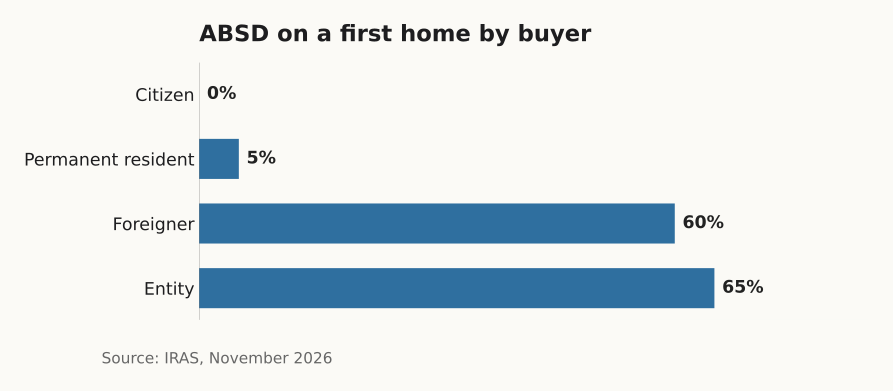
ABSD on a first residential property by buyer profile. Source: IRAS, November 2026.
The FTA carve-out
One group of foreigners escapes the 60% rate. Under Singapore’s free trade agreements, IRAS treats certain buyers as citizens: “Nationals or Permanent Residents of the following countries will be accorded the same stamp duty treatment as Singapore Citizens: 1. Nationals and Permanent Residents of Iceland, Liechtenstein, Norway or Switzerland; 2. Nationals of the United States of America.”
Note the asymmetry — for the four European jurisdictions both nationals and PRs qualify, but for the United States only nationals do (a US green-card holder who is not a citizen still pays 60%). A qualifying buyer pays “no ABSD on your first property purchase”, then 20% and 30% on a second and third, exactly as a citizen would.
Financing and other costs
A foreigner can take a Singapore bank loan, and the same MAS loan-to-value cap — up to 75% of price or value for a first housing loan — applies. But two things bite harder than for a local buyer:
- No CPF. Foreigners have no CPF Ordinary Account, so the entire non-loan portion of the price, plus all stamp duty and legal fees, must be cash.
- ABSD cannot be borrowed. The loan is sized against the property price only, so the 60% ABSD sits entirely on top as cash you provide.
Beyond purchase, owners pay annual property tax on the home’s Annual Value — see the property tax guide — and non-owner-occupier rates apply if you do not live in it. How the all-in cost compares with public housing is in private property vs HDB cost.
A worked cost example
Frequently asked questions
Can a foreigner buy a condo in Singapore? Yes. A condominium or private apartment unit needs no approval under the Residential Property Act for any foreign person.
Can a foreigner buy a landed house or a Sentosa Cove property? Only with SLA approval, which broadly requires at least five years as a PR plus an exceptional economic contribution, assessed case by case.
Can a foreigner buy an HDB flat? Not as a pure foreigner. HDB requires the buyer to be a citizen or PR, with PRs needing at least three years of PR status and a qualifying household.
Which foreigners avoid the 60% ABSD? Nationals and PRs of Iceland, Liechtenstein, Norway and Switzerland, and nationals (not PRs) of the United States — they are taxed as citizens, so 0% on a first home.
Is PR status enough to buy anything? A PR is still a foreign person under the Act for landed property, but pays only 5% ABSD on a first private home and can buy an HDB resale flat after three years of PR status.
Related
- ABSD on a second property
- Private property vs HDB: the cost
- New launch vs resale condo
- Property tax in Singapore
General information, not legal, tax or financial advice. Confirm current rules with SLA, IRAS and HDB before you commit. We do not represent buyers or sellers.
Sources
- Foreign ownership of property (Residential Property Act) — Singapore Land Authority (as of November 2026)
- Additional Buyer's Stamp Duty (ABSD) — Inland Revenue Authority of Singapore (as of November 2026)
- Foreigners Eligible for ABSD Remission under Free Trade Agreements (FTAs) — Inland Revenue Authority of Singapore (as of November 2026)
- Buyer's Stamp Duty (BSD) — Inland Revenue Authority of Singapore (as of November 2026)
- Terms and Conditions of Sale and Purchase of an HDB Resale Flat — Housing & Development Board (as of November 2026)